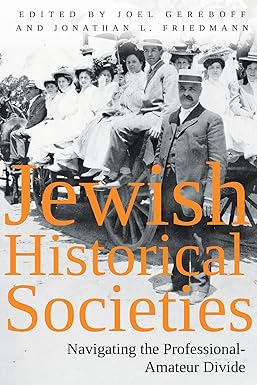
This volume examines American Jewish historical societies, their work, limitations, and place in wider history.
Jewish History, Locally
Come here for
- Accounts from six regional society leaders
- A chronologically arranged appendix of societies, missions, and publications
Expect
- Discussion of tensions between amateur and professional historical practice
- Coverage spanning New England, the Midwest, South, Southwest, and West
Where it sits
How strongly BookFrontier reads the book as belonging to each subject.
Nearest books
Matched by our semantic model. Ordered by what its readers also loved. Most of these share its genre: Jewish History.
 Antisemitism, an American TraditionPamela S Nadell57% subject match
 The Jewish Anarchist Movement in AmericaJoseph Cohen57% subject match
 My Jewish YearAbigail Pogrebin57% subject match
 Recovering JewishnessFrederick S. Roden56% subject match
 The Holocaust In American LifePeter Novick55% subject match
 Jewish Religious Music in Nineteenth-Century AmericaJudah M. Cohen55% subject match
For younger readers: What Jewish Looks Like, Tough Questions Jews Ask 2/E, How Do You Jew?
Start with three books, and this one can be the first.
Members get a new edition every morning: a route out from their books to essays, research and talks, with the reason for each.
Sign upAbout this book
Since the early 1950s, local and regional historical societies have been an important part of the American Jewish landscape, providing community outreach, housing archives, fostering research, and publishing historical studies. This book charts the development, undertakings, successes, shortcomings, and possible future of local and regional Jewish historical societies in the United States.
Continue reading
The lead chapter, by Joel Gereboff, explores the challenges of constructing and presenting Jewish history and what disparities exist between amateur historians and professionals in regards to standards, tools, methods, analysis, and contextualization. Following an overview of key players, major themes, representative organizations, and recurring critiques, the chapter proposes ways to address the essential question: Can Jewish history on the local and regional levels be more inclusive, better integrated with broader trends of Jewish and general history, and improved according to scholarly norms and expectations of social history?
Following this are six chapters by leaders of local and regional Jewish historical societies: George M. Goodwin of the Rhode Island Jewish Historical Association; Jonathan L. Friedmann of the Western States Jewish History Association; Mark K. Bauman of the Southern Jewish Historical Society; Catherine Cangany of the Jewish Historical Society of Michigan; Jeanne Abrams of the Rocky Mountain Jewish Historical Society; and Lawrence Bell of the Arizona Jewish Historical Society. The selected societies cover major regions of the country—New England, Midwest, South, Southwest, and West—and, as such, are representative of the broader phenomenon of American Jewish historical societies. These chapters are followed by a chronologically arranged appendix listing American Jewish historical societies, their mission statements, and their publications.
Historical grounding is imperative for an understanding of community and self. Equally essential is the type of information that makes up that history, as well as how that information is recounted and interpreted. No individual or community exists in isolation; human history is complex, multilayered, and interwoven. While all history may be local, it does not exist in a vacuum—this volume illuminates that concept and situates it within the Jewish historical landscape.
Publisher details
Publisher categories
- Jewish History
- History Resources
- Conservative Judaism
- Authors
- Jonathan L. Friedmann, Joel Gereboff
- Publisher
- Texas Tech University Press
- Published
- May 23, 2023
- Format
- Print & ebook
- Reading lane
- Jewish History