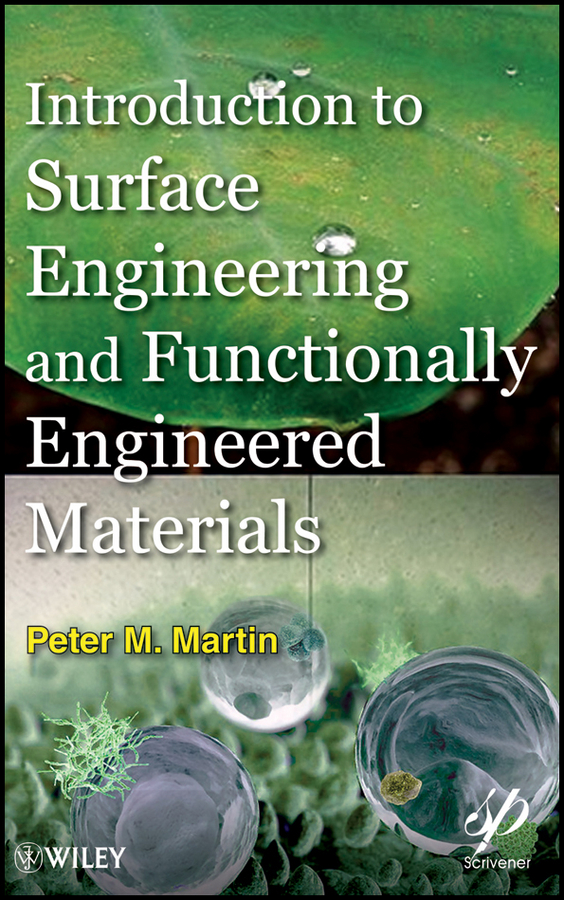
Introduction to Surface Engineering and Functionally Engineered Materials
1st Edition
Series: Wiley-Scrivener
Explore how surface engineering changes solid properties through thin films and coatings.
- Themes
- Surface engineering, Thin-film technology, Engineered materials
Engineering Thin-Film Surfaces
Come here for
- Examples of technologies and their uses
- Synthesis processes involved
Expect
- Thin-film coatings
- Plasma treatment
Where it sits
How strongly BookFrontier reads the book as belonging to each subject.
Nearest books
Matched by our semantic model. Ordered by what its readers also loved.
 Electronic Properties of MaterialsRolf E. Hummel64% subject matchShares Electronic Materials and Condensed Matter Physics
 Surface and Interface AnalysisSeong H. Kim64% subject matchShares Thin Films & Surfaces and Condensed Matter Physics
 2D and 3D NanostructuresJean-Claude Serge Levy59% subject matchShares Condensed Matter Physics
 Physical ElectrochemistryNoam Eliaz, Eliezer Gileadi58% subject match
 Solid-State PhysicsHarald Ibach58% subject matchShares Condensed Matter Physics
 Computational Modelling of Additive ManufacturingWentao Yan, Yanming Zhang57% subject match
 The Supramolecular Chemistry of Organic-Inorganic Hybrid MaterialsKnut Rurack, Ramon Martinez-Manez56% subject match
 Electrochemical EngineeringThomas F. Fuller, John N. Harb56% subject match
For younger readers: CHEM MAT & CHG SE
Start with three books, and this one can be the first.
Members get a new edition every morning: a route out from their books to essays, research and talks, with the reason for each.
Sign upAbout this book
This book provides a clear and understandable text for users and developers of advanced engineered materials, particularly in the area of thin films, and addresses fundamentals of modifying the optical, electrical, photo-electric, triboligical, and corrosion resistance of solid surfaces and adding functionality to solids by engineering their surface, structure, and electronic, magnetic and optical structure. Thin film applications are emphasized.
Continue reading
Through the inclusion of multiple clear examples of the technologies, how to use them,and the synthesis processes involved, the reader will gain a deep understanding of the purpose, goals, and methodology of surface engineering and engineered materials.
Virtually every advance in thin film, energy, medical, tribological materials technologies has resulted from surface engineering and engineered materials. Surface engineering involves structures and compositions not found naturally in solids and is used to modify the surface properties of solids and involves application of thin film coatings, surface functionalization and activation, and plasma treatment. Engineered materials are the future of thin film technology. Engineered structures such as superlattices, nanolaminates, nanotubes, nanocomposites, smart materials, photonic bandgap materials, metamaterials, molecularly doped polymers and structured materials all have the capacity to expand and increase the functionality of thin films and coatings used in a variety of applications and provide new applications. New advanced deposition processes and hybrid processes are being used and developed to deposit advanced thin film materials and structures not possible with conventional techniques a decade ago. Properties can now be engineered into thin films that achieve performance not possible a decade ago.
Publisher details
Publisher categories
- Thin Films & Surfaces
- Authors
- Peter Martin
- Publisher
- Wiley
- Published
- September 6, 2011
- Format
- Print & ebook
- Reading lane
- Thin Films & Surfaces