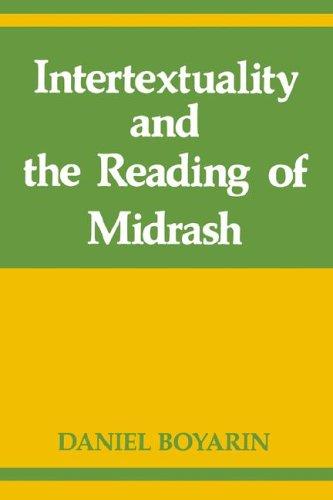
Intertextuality and the Reading of Midrash
Close readings of the Mekilta frame a theory of midrash, ideology, and interpretation.
Reading the Mekilta
Come here for
- Close readings of passages from the early midrash on Exodus
Expect
- A theory attentive to biblical heterogeneity
- Questions about the interplay of history, ideology, and interpretation
Where it sits
How strongly BookFrontier reads the book as belonging to each subject.
Nearest books
Matched by our semantic model. Ordered by what its readers also loved.
 Modern Orthodox JudaismMenachem-Martin Gordon64% subject match
 Palestine and Jewish HistoryJonathan Boyarin59% subject match
 The Aura of TorahLarry Tabick59% subject match
 How to Read the BibleMarc Zvi Brettler59% subject matchShares Old Testament Interpretation
 Smashing the TabletsSara Lippmann, Seth Rogoff58% subject matchShares Jewish Literary Criticism and Old Testament Interpretation
 It Takes Two to TorahAbigail Pogrebin, Rabbi Dov Linzer58% subject match
 Changing the ImmutableMarc B. Shapiro58% subject match
 The Heart of Torah, Volume 2Shai Held58% subject match
For younger readers: With a Mighty Hand, Tough Questions Jews Ask 2/E
Start with three books, and this one can be the first.
Members get a new edition every morning: a route out from their books to essays, research and talks, with the reason for each.
Sign upAbout this book
Proceeding by means of intensive readings of passages from the early midrash on Exodus The Mekilta, Boyarin proposes a new theory of midrash that rests in part on an understanding of the heterogeneity of the biblical text and the constraining force of rabbinic ideology on the production of midrash. In a forceful combination of theory and reading, Boyarin raises profound questions concerning the interplay between history, ideology, and interpretation.
Publisher details
Publisher categories
- Old Testament Interpretation
- Authors
- Daniel Boyarin
- Publisher
- Indiana University Press
- Published
- August 22, 1994
- Format
- Print & ebook
- Reading lane
- Old Testament Interpretation