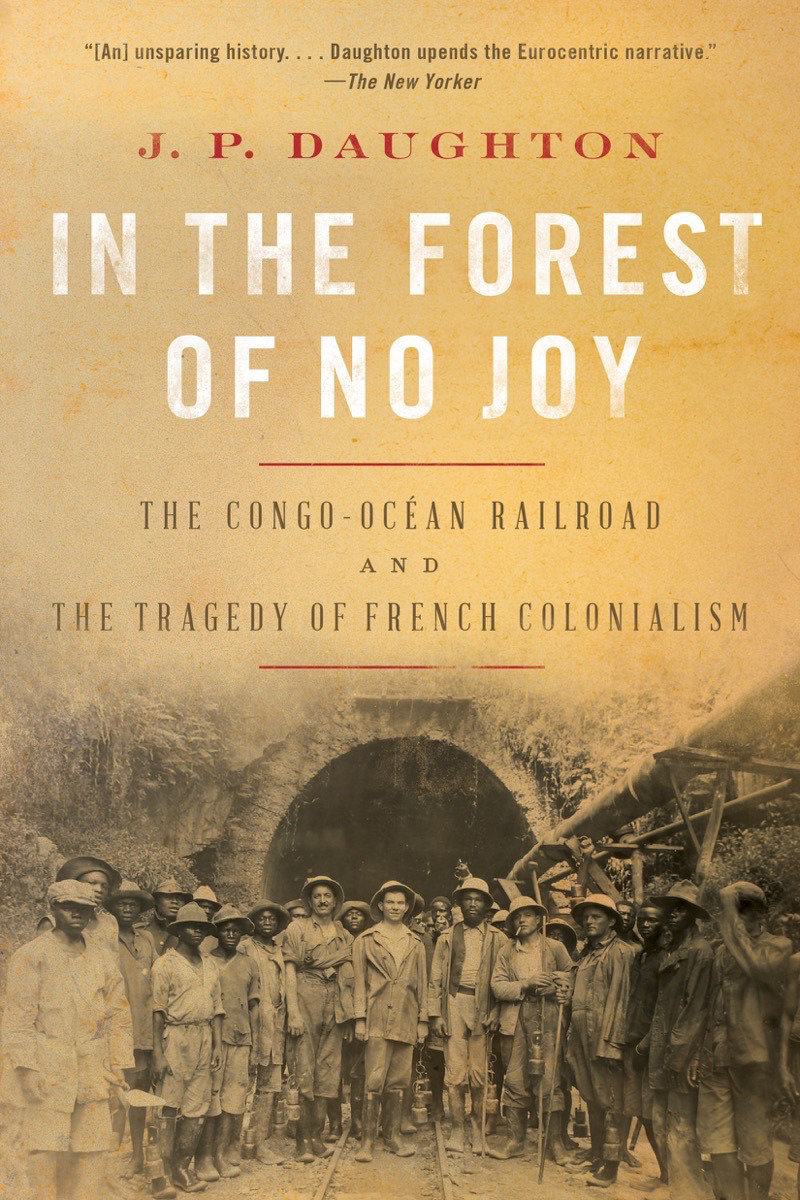
In the Forest of No Joy
The Congo-ocean Railroad and the Tragedy of French Colonialism
J. P. Daughton brings the railroad’s brutal construction and colonial contradictions into sharp historical focus.
Empire’s Contradictions
Come here for
- The Congo-Océan railroad’s history and the human cost of colonial rule
- A close look at the clash between liberal ideals and imperial practice
Expect
- A vivid account of workers’ experiences, grounded in archival records and photographs
- A sustained examination of empire, industrial ambition, and humanitarian ideals
Where it sits
How strongly BookFrontier reads the book as belonging to each subject.
Nearest books
Matched by our semantic model. Ordered by what its readers also loved. Most of these share its genre: Colonialism & Its Aftermath.
 The Tears of a Man Flow InwardPacifique Irankunda46% subject match
 White MaliceSusan Williams50% subject match
 Born in BlacknessHoward W. French55% subject match
 Land of TearsRobert Harms60% subject matchAlso shares Central African History
 The Gifts of AfricaJeff Pearce47% subject match
 The Second EmancipationHoward W. French52% subject match
 A Training School for ElephantsSophy Roberts60% subject match
 Another America: The Story of Liberia and the Former Slaves Who Ruled ItJames Ciment54% subject match
For younger readers: History Comics: The Transcontinental Railroad, Silver People, Imperialism
Start with three books, and this one can be the first.
Members get a new edition every morning: a route out from their books to essays, research and talks, with the reason for each.
Sign upAbout this book
Shortlisted for the 2022 Cundill History Prize
Shortlisted for the 2022 American Library in Paris Book Award
The epic story of the Congo-Océan railroad and the human costs and contradictions of modern empire.
The Congo-Océan railroad stretches across the Republic of Congo from Brazzaville to the Atlantic port of Pointe-Noir. It was completed in 1934, when Equatorial Africa was a French colony, and it stands as one of the deadliest construction projects in history.
Continue reading
Colonial workers were subjects of an ostensibly democratic nation whose motto read “Liberty, Equality, Fraternity,” but liberal ideals were savaged by a cruelly indifferent administrative state.
African workers were forcibly conscripted and separated from their families, and subjected to hellish conditions as they hacked their way through dense tropical foliage—a “forest of no joy”; excavated by hand thousands of tons of earth in order to lay down track; blasted their way through rock to construct tunnels; or risked their lives building bridges over otherwise impassable rivers. In the process, they suffered disease, malnutrition, and rampant physical abuse, likely resulting in at least 20,000 deaths.
In the Forest of No Joy captures in vivid detail the experiences of the men, women, and children who toiled on the railroad, and forces a reassessment of the moral relationship between modern industrialized empires and what could be called global humanitarian impulses—the desire to improve the lives of people outside of Europe. Drawing on exhaustive research in French and Congolese archives, a chilling documentary record, and heartbreaking photographic evidence, J.P. Daughton tells the epic story of the Congo-Océan railroad, and in doing so reveals the human costs and contradictions of modern empire.
Publisher details
Publisher categories
- Central African History
- French History
- 20th-Century History
- Authors
- J. P. Daughton
- Publisher
- WW Norton
- Published
- March 28, 2023
- Format
- Print & ebook
- Reading lane
- Central African History