
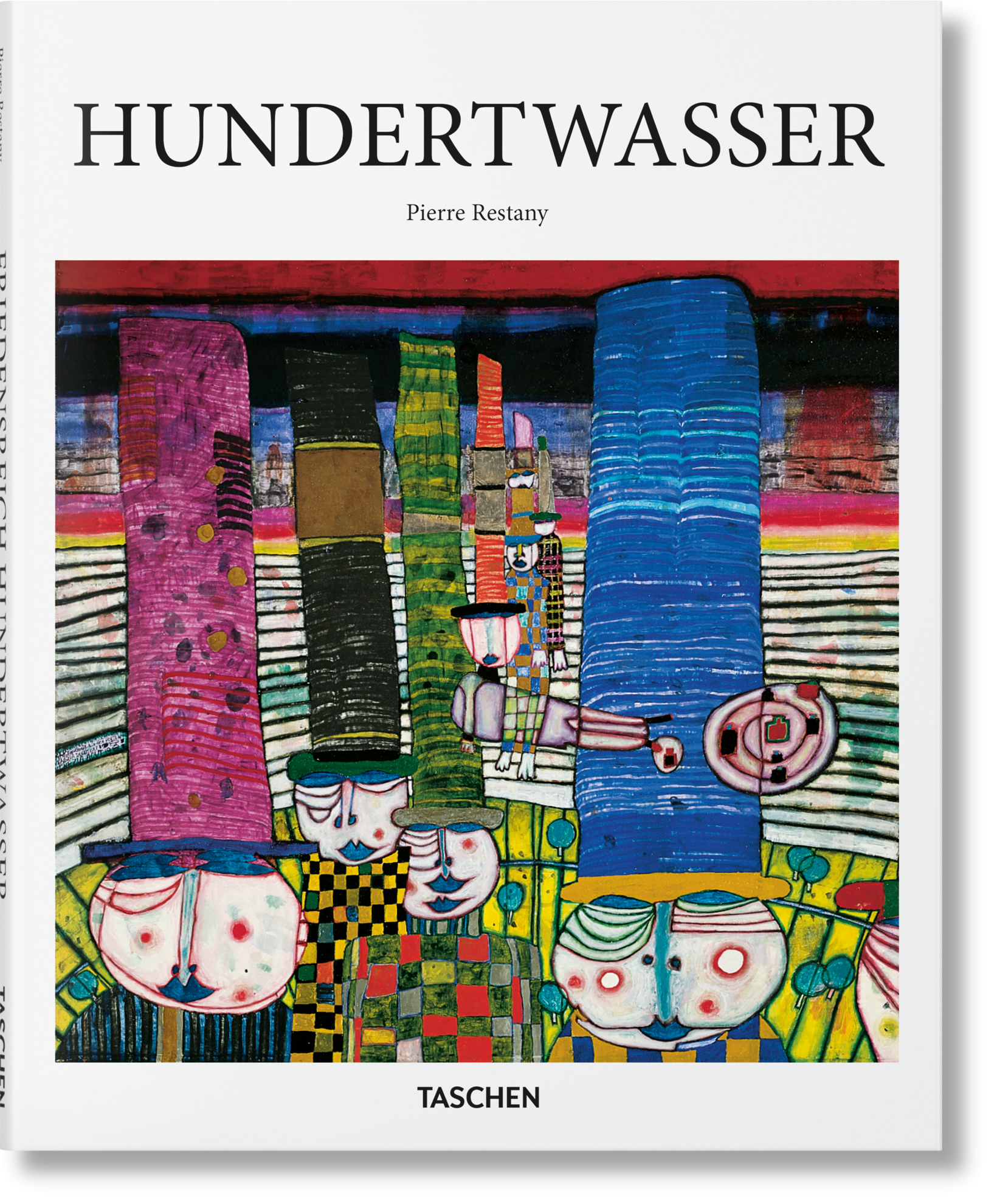
Book
Hundertwasser
Pierre Restany
TASCHEN · Hardcover · July 19, 2018
Reading lane: Contemporary Architecture (1945-)
Vivid color, organic forms, and a loathing of straight lines were just a few stalwart characteristics in the unique practice of Friedensreich Hundertwasser (1928–2000).
At a Glance
Who It's For
Book Details
- Authors
- Pierre Restany
- Publisher
- TASCHEN
- Published
- July 19, 2018
- Format
- Hardcover
- Theme
- Contemporary Architecture (1945-) · Architect Monographs
- Reading lane
- Contemporary Architecture (1945-)
Affinity
Publisher Categories
Contemporary Architecture (1945-)
Architect Monographs
Contemporary Art History (1945-)
Artist Monographs
About This Book
Vivid color, organic forms, and a loathing of straight lines were just a few stalwart characteristics in the unique practice of Friedensreich Hundertwasser (1928–2000). A non-conformist hero, the artist, architect, and activist left a blazing trail of imagination and ideas in buildings, paintings, manifestos, initiatives, and more. Hundertwasser’s best-known work is considered by many to be the Hundertwasserhaus in Vienna, a structural synthesis of the vitality and uniquenes...
Read full description
Similar Books

Gerhard Richter
Dieter Schwarz, Nicholas Serota · Citadelles & Mazenod
Affinity signal
ART / European / German & Austrian
Artist Monographs

Gerhard Richter
Benjamin H. D. Buchloh · MIT Press
Affinity signal
ART / European / German & Austrian
Contemporary Art History (1945-)
From Bauhaus to Our House
Tom Wolfe · Picador
Affinity signal
Modern Architecture (to 1945)
Contemporary Architecture (1945-)

Richard Rogers on Modern Architecture
Richard Rogers · WW Norton
Affinity signal
Contemporary Architecture (1945-)
Modern Architecture (to 1945)

Makers of Modern Architecture
Martin Filler · New York Review Books
Affinity signal
Modern Architecture (to 1945)
Contemporary Architecture (1945-)

The Bauhaus Ideal Then and Now
William Smock · Chicago Review Press
Affinity signal
Modern Architecture (to 1945)
Contemporary Architecture (1945-)

100 Years, 100 Buildings
John Hill · Prestel
Affinity signal
Contemporary Architecture (1945-)
Modern Architecture (to 1945)

I Paint What I Want to See
Philip Guston · Penguin UK
Affinity signal
Artist Essays
Artist Monographs