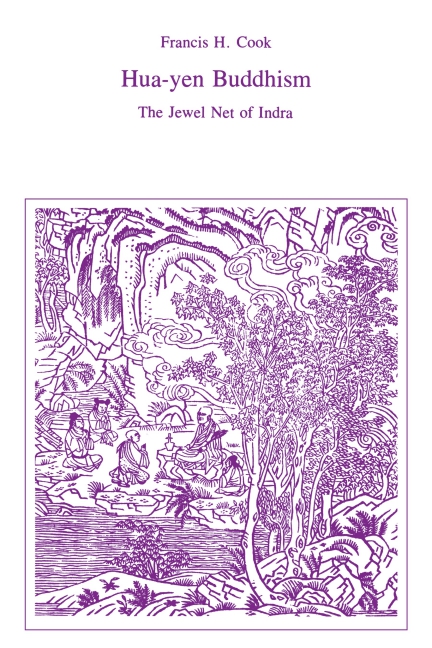
Hua-Yen Buddhism
The Jewel Net of Indra
Where it sits
How strongly BookFrontier reads the book as belonging to each subject.
Nearest books
Matched by our semantic model. Ordered by what its readers also loved.
 Awakening of the HeartThich Nhat Hanh47% subject match
 The Platform SutraRed Pine, Hui-Neng55% subject match
 The Essence of ShintoMotohisa Yamakage43% subject match
 The Diamond SutraRed Pine50% subject matchShares Buddhist Thought
 The Zen Teaching of BodhidharmaBodhidharma, Red Pine52% subject match
 The Holy Teaching of VimalakīrtiRobert A. F. Thurman52% subject matchShares Buddhist Thought
 The Perennial PhilosophyAldous Huxley52% subject match
 Zen in the Art of ArcheryEugen Herrigel50% subject match
For younger readers: Wide Awake
Start with three books, and this one can be the first.
Members get a new edition every morning: a route out from their books to essays, research and talks, with the reason for each.
Sign upAbout this book
Hua-yen is regarded as the highest form of Buddhism by most modern Japanese and Chinese scholars. This book is a description and analysis of the Chinese form of Buddhism called Hua-yen (or Hwa-yea), Flower Ornament, based largely on one of the more systematic treatises of its third patriarch. Hua-yen Buddhism strongly resembles Whitehead's process philosophy, and has strong implications for modern philosophy and religion.
Continue reading
Hua-yen Buddhism explores the philosophical system of Hua-yen in greater detail than does Garma C.C. Chang's The Buddhist Teaching of Totality (Penn State, 1971). An additional value is the development of the questions of ethics and history. Thus, Professor Cook presents a valuable sequel to Professor Chang's pioneering work. The Flower Ornament School was developed in China in the late 7th and early 8th centuries as an innovative interpretation of Indian Buddhist doctrines in the light of indigenous Chinese presuppositions, chiefly Taoist. Hua-yen is a cosmic ecology, which views all existence as an organic unity, so it has an obvious appeal to the modern individual, both students and layman. Read more
Publisher details
Publisher categories
- Buddhist Thought
- Buddhism - General
- Buddhist Practice & Ritual
- Buddhist Sacred Writings
Show all 5 publisher categories
- Religious Ethics
- Authors
- Francis H. Cook
- Publisher
- Penn State University Press
- Published
- September 15, 1977
- Format
- Print & ebook
- Reading lane
- Buddhist Thought