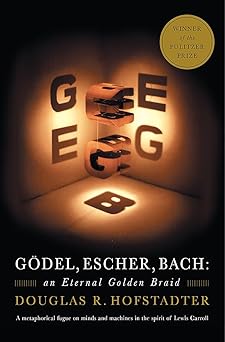
Gödel, Escher, Bach
An Eternal Golden Braid
A brainy braid of art, science, and philosophy that stays surprisingly readable.
- Themes
- consciousness, self-reference, cognitive science
- Pacing
- Reflective
Braided Ideas
Come here for
- rigorous cross-disciplinary play
- dip-in sections that reward curiosity
Expect
- cultural-literacy density
- edgy, idea-forward detours
Where it sits
How strongly BookFrontier reads the book as belonging to each subject.
Nearest books
Matched by our semantic model. Ordered by what its readers also loved.
 Surely You're Joking, Mr. Feynman!Richard P Feynman, Ralph Leighton53% subject match
 Permutation CityGreg Egan52% subject match
 A Perfect VacuumStanislav Lem50% subject match
 The Singularity Is NearRay Kurzweil49% subject match
 Einstein's DreamsAlan Lightman59% subject match
For younger readers: Ludwig and the Rhinoceros, Alphamaniacs, Makers
Start with three books, and this one can be the first.
Members get a new edition every morning: a route out from their books to essays, research and talks, with the reason for each.
Sign upAbout this book
Winner of the Pulitzer Prize and National Book Award
A metaphorical fugue on minds and machines in the spirit of Lewis Carroll
“Every few decades an unknown author brings out a book of such depth, charity, range, wit, beauty, and originality that it is recognized at once as a major literary event. This is such a work.” —Scientific American
Continue reading
GEB is a unique insight into the nature of “I,” self, soul, and consciousness, centered on a notion that its youthful author dubbed “strange loop,” inspired by the twisty self-referential construction invented by logician Kurt Gödel, whereby a sentence asserts its own unprovability. The book’s chapters alternate with Bach-like contrapuntal dialogues between whimsical characters (especially Achilles and the Tortoise), and each dialogue’s intricate structure exemplifies the notion being discussed in it, thus creating indirect self-reference (a fact unsuspected by the characters). The book, filled with analogies, wordplay, humor, and mind-twisting prints by M. C. Escher, has inspired generations of bright students to study cognitive science and the philosophy of mind.
Publisher details
Publisher categories
- Computation Theory
- Mathematical Logic
- Philosophy
- Authors
- Douglas R Hofstadter
- Publisher
- Basic Books
- Published
- February 5, 1999
- Format
- Print & ebook
- Reading lane
- Computation Theory