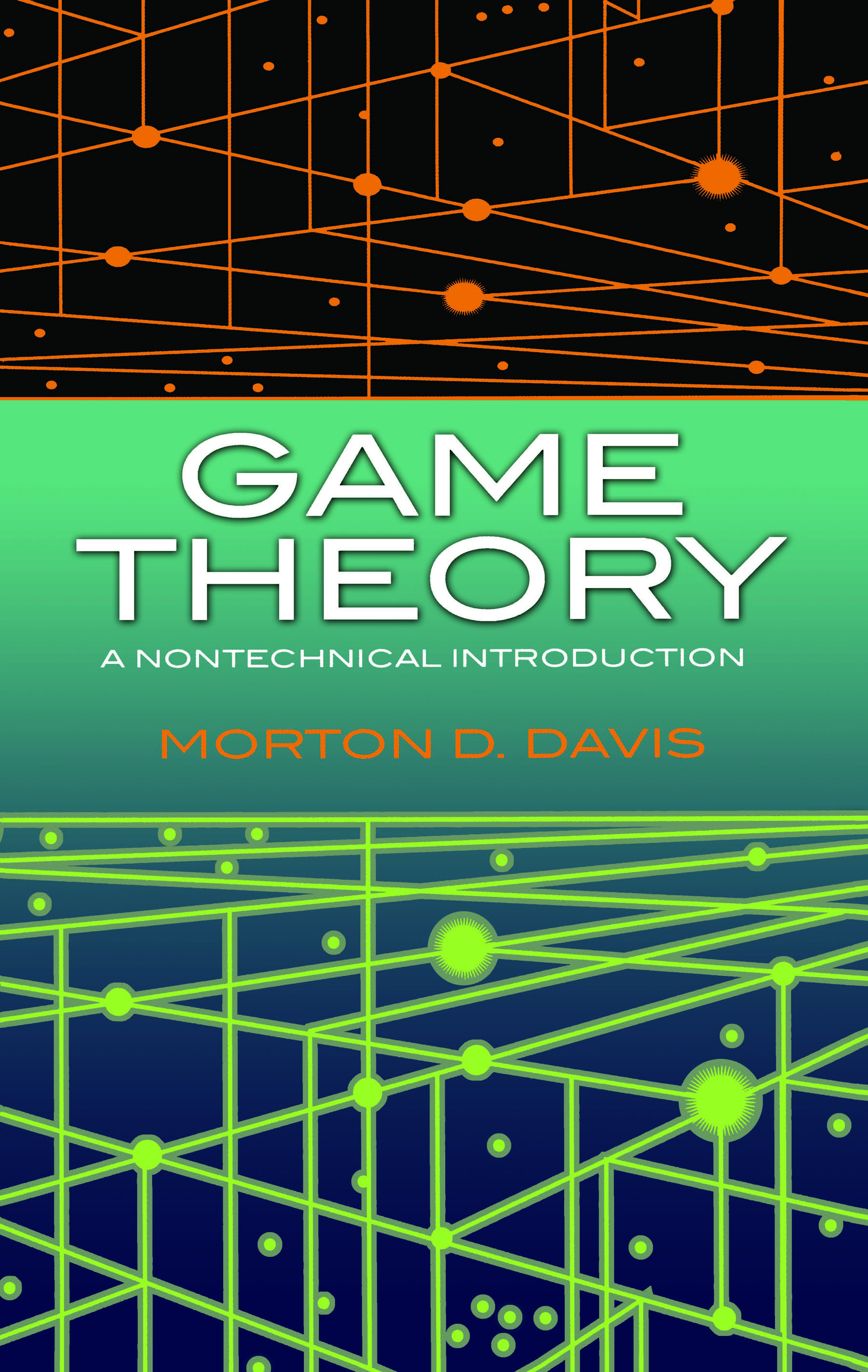
Explore how game theory turns everyday choices and conflicts into questions you can reason through.
- Themes
- Game theory, Strategic decision-making, Social and economic applications
Strategic Intuition
Come here for
- A nontechnical path into a field with mathematical foundations
- Examples spanning business, politics, and everyday decisions
Expect
- Chapter-opening problems invite your own common-sense solutions
- A progression from two-person games to n-person games
Where it sits
How strongly BookFrontier reads the book as belonging to each subject.
Nearest books
Matched by our semantic model. Ordered by what its readers also loved.
 The Equations WorldBoris Pritsker50% subject match
 The Art of StrategyAvinash K Dixit, Barry J Nalebuff73% subject matchShares Game Theory and Decision-Making & Problem Solving
 Prisoner's DilemmaWilliam Poundstone67% subject matchShares Game Theory
 Bridge Basics 1Audrey Grant58% subject match
 Theory of Fun for Game DesignRaph Koster57% subject match
 Modern Poker TheoryMichael Acevedo56% subject matchShares Game Theory
 The Winner's CurseRichard H. Thaler, Alex Imas55% subject match
 Watson's Classic BookLouis H. Watson55% subject match
For younger readers: Game On!
Start with three books, and this one can be the first.
Members get a new edition every morning: a route out from their books to essays, research and talks, with the reason for each.
Sign upAbout this book
"A lucid and penetrating development of game theory that will appeal to the intuition . . . a most valuable contribution." — Douglas R. Hofstadter, author of Gödel, Escher, Bach
The foundations of game theory were laid by John von Neumann, who in 1928 proved the basic minimax theorem, and with the 1944 publication of the Theory of Games and Economic Behavior, the field was established.
Continue reading
Since then, game theory has become an enormously important discipline because of its novel mathematical properties and its many applications to social, economic, and political problems.
Game theory has been used to make investment decisions, pick jurors, commit tanks to battle, allocate business expenses equitably — even to measure a senator's power, among many other uses. In this revised edition of his highly regarded work, Morton Davis begins with an overview of game theory, then discusses the two-person zero-sum game with equilibrium points; the general, two-person zero-sum game; utility theory; the two-person, non-zero-sum game; and the n-person game.
A number of problems are posed at the start of each chapter and readers are given a chance to solve them before moving on. (Unlike most mathematical problems, many problems in game theory are easily understood by the lay reader.) At the end of the chapter, where solutions are discussed, readers can compare their "common sense" solutions with those of the author. Brimming with applications to an enormous variety of everyday situations, this book offers readers a fascinating, accessible introduction to one of the most fruitful and interesting intellectual systems of our time.
Publisher details
Publisher categories
- Teaching Math
- Game Theory
- Authors
- Morton D. Davis
- Publisher
- Dover Publications
- Published
- July 1, 1997
- Format
- Print & ebook
- Reading lane
- Teaching Math