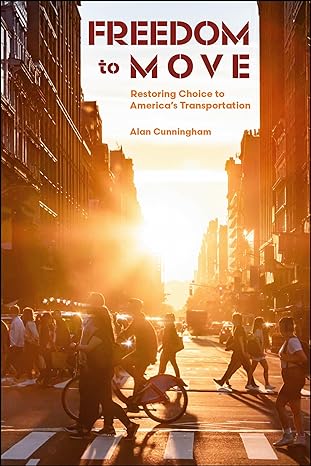
Freedom to Move
Restoring Choice to America's Transportation
A history of car-centered American development opens onto alternatives around rail stations.
Rail Station Land Use
Come here for
- A history of traffic-centered transportation in the United States
- A proposal for bikeable development around existing rail stations
Expect
- An argument for more transportation choice, grounded in data
- Potential benefits including safety, fitness, affordability, and cleaner air and water
Where it sits
How strongly BookFrontier reads the book as belonging to each subject.
Nearest books
Matched by our semantic model. Ordered by what its readers also loved. Most of these share its genres: Cities & Urban Planning and Urban & Land Use Planning.
 Shifting GearsSusan Handy67% subject match
 Confessions of a Recovering EngineerCharles L. Marohn, Jr.63% subject match
 Transportation for Livable CitiesVukan Vuchic62% subject matchAlso shares Public Transit
 Inclusive TransportationVeronica Davis60% subject match
 Walkable CityJeff Speck60% subject match
 Roadways for PeopleLynn Peterson, Elizabeth Doerr60% subject match
 Door to DoorEdward Humes59% subject match
 City LimitsMegan Kimble57% subject match
For younger readers: Pedal Power, Transportation!, The Cities of the Future
Start with three books, and this one can be the first.
Members get a new edition every morning: a route out from their books to essays, research and talks, with the reason for each.
Sign upAbout this book
What if transit stations enabled land use for the sake of walkability and bikeability as much as parking lots dictate land use for the sake of traffic? For over a century, the United States has been devoted to traffic as the predominant mode of transportation. We live further apart, personal vehicles have become expensive obligations, and the availability of parking and traffic flow is an essential concern in urban development.
Continue reading
Freedom to Move tells the engaging history of how we got here. While acknowledging our current reality, this book asks how we can improve it. By redeveloping land use within a three-mile bikeable radius of existing rail transit stations, we could realize immense improvements to safety, fitness, affordability, water and air quality, public health, and real estate markets. The author uses data to argue for freedom of choice?how we can move beyond the inevitability of car dependence, and how that benefits all of us.
Publisher details
Publisher categories
- Cities & Urban Planning
- Transport Engineering
- Public Transit
- Authors
- Alan Cunningham
- Publisher
- Purdue University Press
- Published
- March 15, 2026
- Format
- Print & ebook
- Reading lane
- Cities & Urban Planning