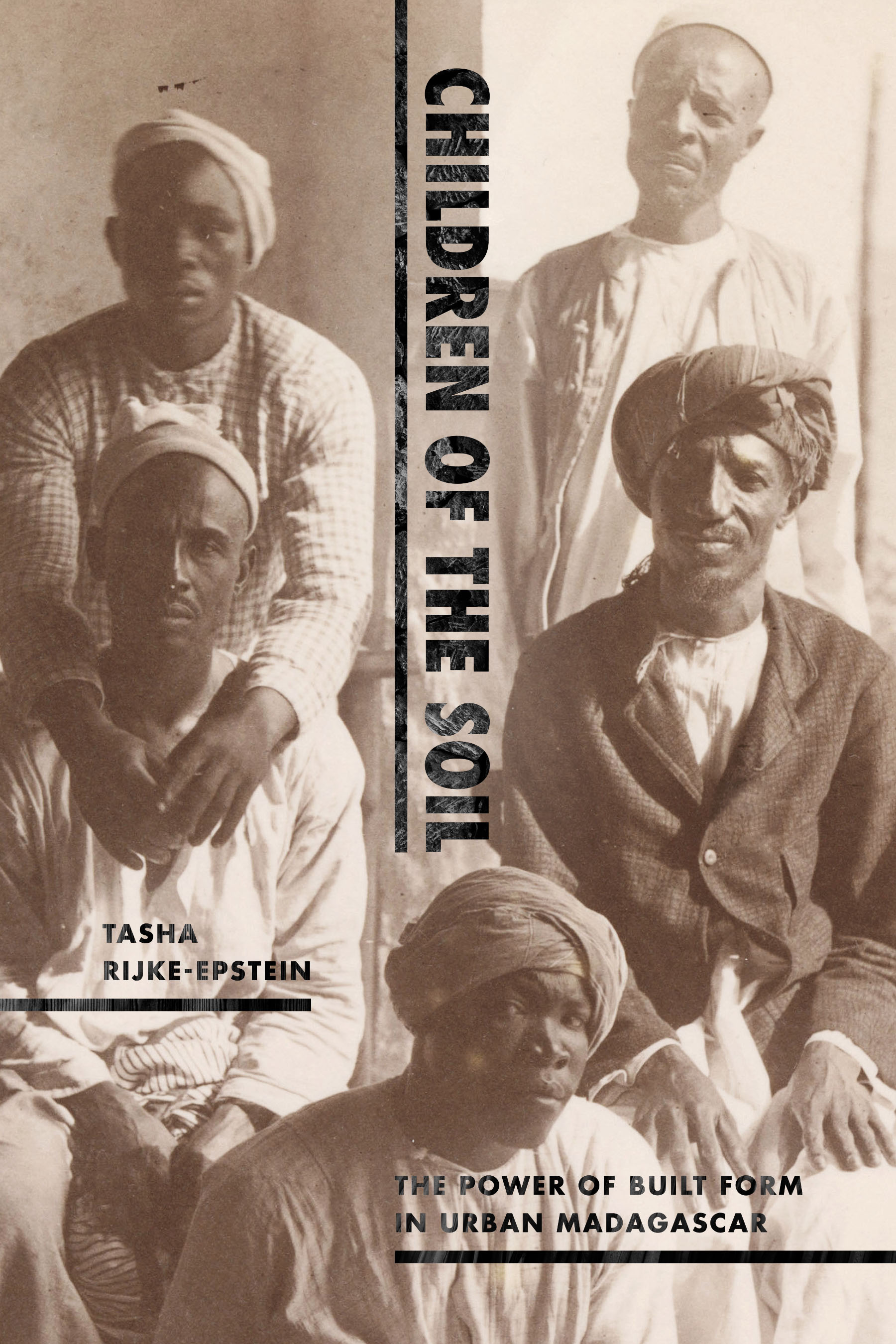
Children of the Soil
The Power of Built Form in Urban Madagascar
Mahajanga’s architecture reveals how residents contested power and claimed urban belonging across two centuries.
Mahajanga’s Built World
Come here for
- A port city’s hilltop palace and cesspools
- Competing claims over people, land, and urban belonging
Expect
- An urban history before, during, and after colonization
- Attention to architecture, ancestry, and ecological pasts
Where it sits
How strongly BookFrontier reads the book as belonging to each subject.
Nearest books
Matched by our semantic model. Ordered by what its readers also loved.
 Tragedy of MadagascarNathaniel Adams55% subject matchShares African History and Colonialism & Its Aftermath
 Empire UnseenMelanie Lamotte53% subject matchShares Colonialism & Its Aftermath
 The Gardens of MarsJohn Gimlette51% subject matchShares African History
 The City ElectricMichael Degani48% subject match
 Monrovia ModernDanny Hoffman48% subject match
 Decolonizing Maasai HistoryMeitamei Olol Dapash, Mary Poole47% subject matchShares Colonialism & Its Aftermath
 Seattle from the MarginsMegan Asaka47% subject match
For younger readers: Taste of Salt, Manhattan, Harlem Grown
Start with three books, and this one can be the first.
Members get a new edition every morning: a route out from their books to essays, research and talks, with the reason for each.
Sign upAbout this book
In Children of the Soil, Tasha Rijke-Epstein offers an urban history of the port city of Mahajanga, Madagascar, before, during, and after colonization. Drawing on archival and ethnographic evidence, she weaves together the lives and afterlives of built spaces to show how city residents negotiated imperial encroachment, colonial rule, and global racial capitalism over two centuries.
Continue reading
From Mahajanga’s hilltop palace to the alluvial depths of its cesspools, the city’s spaces were domains for ideological debates between rulers and subjects, French colonizers and indigenous Malagasy peoples, and Comorian migrants and Indian traders. In these spaces, Mahajanga’s residents expressed competing moral theories about power over people and the land. The built world was also where varying populations reckoned with human, ancestral, and ecological pasts and laid present and future claims to urban belonging. Migrants from nearby Comoros harnessed built forms as anticipatory devices through which they sought to build their presence into the landscape and transform themselves from outsiders into "children of the soil" (zanatany). In tracing the centrality of Mahajanga’s architecture to everyday life, Rijke-Epstein offers new ways to understand the relationships between the material world, the more-than-human realm, and the making of urban life.
Publisher details
Publisher categories
- Architecture
- East African History
- African Studies
- Authors
- Tasha Rijke-Epstein
- Publisher
- Duke University Press
- Published
- October 31, 2023
- Format
- Print & ebook
- Reading lane
- Architecture