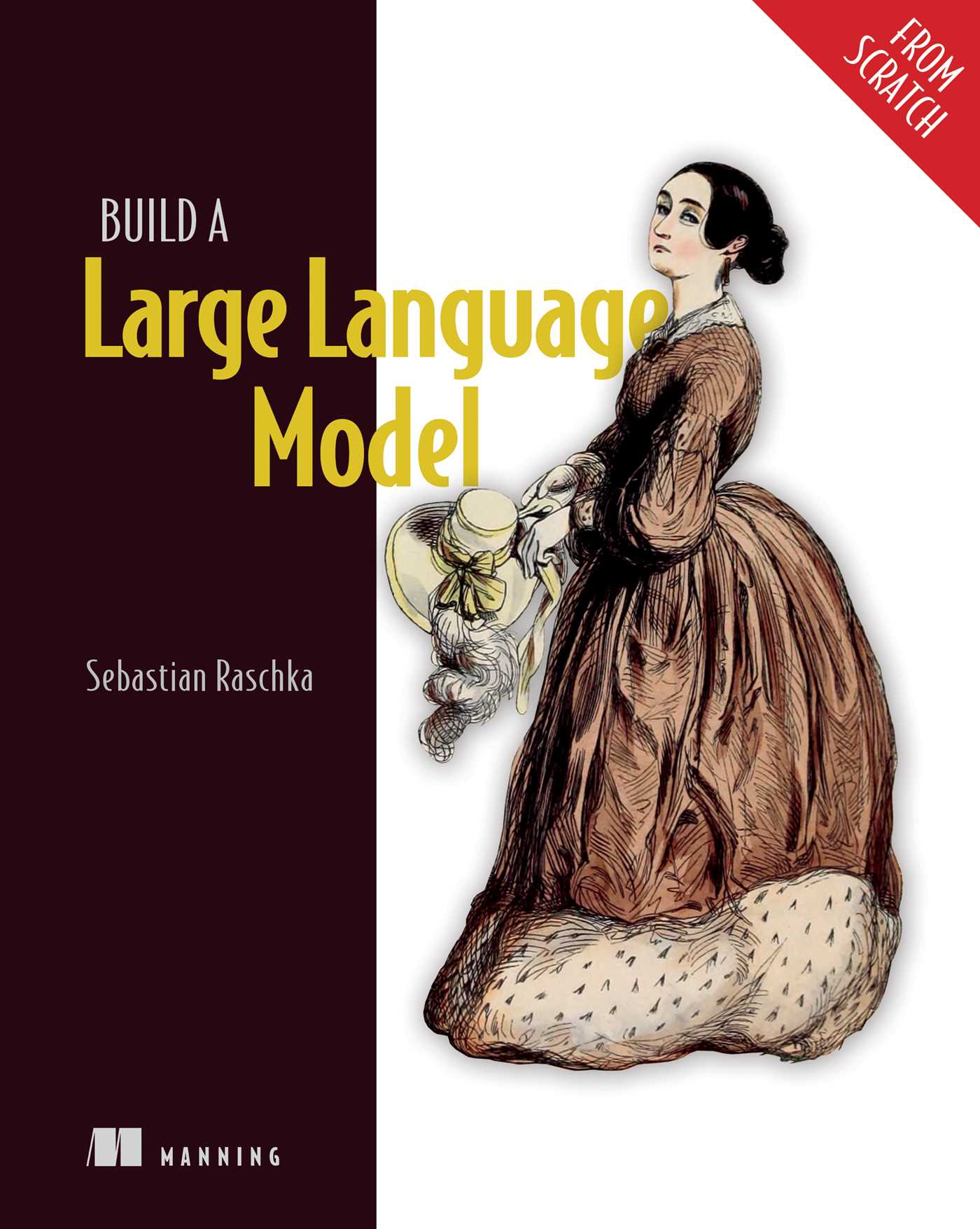
Build a Large Language Model (From Scratch)
Series: From Scratch
A straightforward, build-it-yourself guide with a calm, technical pace.
- Themes
- Artificial Intelligence, Machine Learning, Programming Education
- Pacing
- Steady
Hands-On AI
Come here for
- accessible, hands-on learning
- a practical reference rhythm
Expect
- clear instruction over theory
- toolkit-friendly chapters
Where it sits
How strongly BookFrontier reads the book as belonging to each subject.
Nearest books
Matched by our semantic model. Ordered by what its readers also loved.
 Specifying SystemsLeslie Lamport44% subject match
 WordPress Power ToolkitRichard Mansfield51% subject match
 Quantum Programming in DepthMariia Mykhailova43% subject match
 Time Series Forecasting in PythonMarco Peixeiro48% subject matchShares Machine Learning
 Google BigQuery: The Definitive GuideValliappa Lakshmanan, Jordan Tigani43% subject match
 Build a Reasoning Model (From Scratch)Sebastian Raschka79% subject matchShares Natural Language Processing, Machine Learning and Neural Networks
 Rust in ActionTim McNamara42% subject match
 Deep Learning for Coders with fastai and PyTorchJeremy Howard, Sylvain Gugger48% subject matchShares Natural Language Processing and Machine Learning
For younger readers: STEM Starters for Kids Artificial Intelligence Activity Book, Basher Science Mini: Artificial Intelligence, Python for Kids
Start with three books, and this one can be the first.
Members get a new edition every morning: a route out from their books to essays, research and talks, with the reason for each.
Sign upAbout this book
How to implement LLM attention mechanisms and GPT-style transformers.
In Build a Large Language Model (from Scratch) bestselling author Sebastian Raschka guides you step by step through creating your own LLM. Each stage is explained with clear text, diagrams, and examples. You’ll go from the initial design and creation, to pretraining on a general corpus, and on to fine-tuning for specific tasks.
Build a Large Language Model (from Scratch) teaches you how to:
Continue reading
• Plan and code all the parts of an LLM
• Prepare a dataset suitable for LLM training
• Fine-tune LLMs for text classification and with your own data
• Use human feedback to ensure your LLM follows instructions
• Load pretrained weights into an LLM
Build a Large Language Model (from Scratch) takes you inside the AI black box to tinker with the internal systems that power generative AI. As you work through each key stage of LLM creation, you’ll develop an in-depth understanding of how LLMs work, their limitations, and their customization methods. Your LLM can be developed on an ordinary laptop, and used as your own personal assistant.
Purchase of the print book includes a free eBook in PDF and ePub formats from Manning Publications.
About the technology
Physicist Richard P. Feynman reportedly said, “I don’t understand anything I can’t build.” Based on this same powerful principle, bestselling author Sebastian Raschka guides you step by step as you build a GPT-style LLM that you can run on your laptop. This is an engaging book that covers each stage of the process, from planning and coding to training and fine-tuning.
About the book
Build a Large Language Model (From Scratch) is a practical and eminently-satisfying hands-on journey into the foundations of generative AI. Without relying on any existing LLM libraries, you’ll code a base model, evolve it into a text classifier, and ultimately create a chatbot that can follow your conversational instructions. And you’ll really understand it because you built it yourself!
What's inside
• Plan and code an LLM comparable to GPT-2
• Load pretrained weights
• Construct a complete training pipeline
• Fine-tune your LLM for text classification
• Develop LLMs that follow human instructions
About the reader
Readers need intermediate Python skills and some knowledge of machine learning. The LLM you create will run on any modern laptop and can optionally utilize GPUs.
About the author
Sebastian Raschka is a Staff Research Engineer at Lightning AI, where he works on LLM research and develops open-source software.
The technical editor on this book was David Caswell.
Table of Contents
1 Understanding large language models
2 Working with text data
3 Coding attention mechanisms
4 Implementing a GPT model from scratch to generate text
5 Pretraining on unlabeled data
6 Fine-tuning for classification
7 Fine-tuning to follow instructions
A Introduction to PyTorch
B References and further reading
C Exercise solutions
D Adding bells and whistles to the training loop
E Parameter-efficient fine-tuning with LoRA
Publisher details
Publisher categories
- Neural Networks
- Python Programming
- Machine Learning
- Authors
- Sebastian Raschka
- Publisher
- Manning
- Published
- October 29, 2024
- Format
- Print & ebook
- Reading lane
- Neural Networks