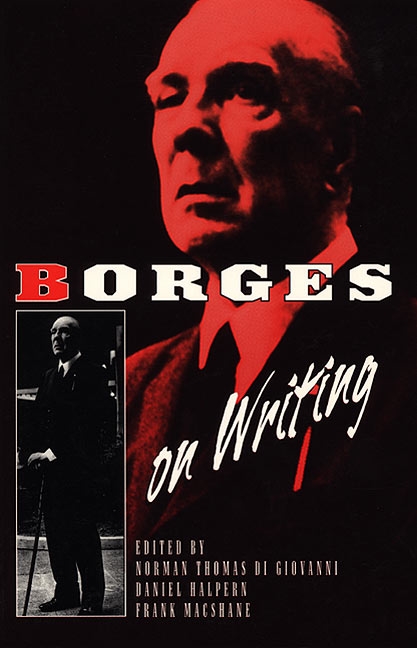
Borges On Writing
Informal seminars bring Borges’s thinking about prose, poetry, and translation into view.
- Themes
- Literary craft and method, Form and structure in poetry, Translation across cultures
- Pacing
- Reflective
Craft in Conversation
Come here for
- A close reading of a story, line by line
- Borges on poetic form and literary translation
Expect
- Discussions with students, an editor, and a writing-program director
- Separate sections on prose, poetry, and translation
Where it sits
How strongly BookFrontier reads the book as belonging to each subject.
Nearest books
Matched by our semantic model. Ordered by what its readers also loved.
 The Call of the TribeMario Vargas Llosa48% subject match
 The Aleph and Other StoriesJorge Luis Borges64% subject match
 Borges and His FictionGene H. Bell-Villada64% subject matchShares Caribbean & Latin American Criticism
 In Our TimeErnest Hemingway45% subject match
For younger readers: Waiting for the Biblioburro/Esperando el Biblioburro, Emerald Lizard
Start with three books, and this one can be the first.
Members get a new edition every morning: a route out from their books to essays, research and talks, with the reason for each.
Sign upAbout this book
Borges On Writing
In 1971, Jorge Luis Borges was invited to preside over a series of seminars on his writing at Columbia University. This book is a record of those seminars, which took the form of informal discussions between Borges, Norman Thomas di Giovanni--his editor and translator, Frank MacShane--then head of the writing program at Columbia, and the students. Borges's prose, poetry, and translations are handled separately and the book is divided accordingly.
Continue reading
The prose seminar is based on a line-by-line discussion of one of Borges's most distinctive stories, "The End of the Duel." Borges explains how he wrote the story, his use of local knowledge, and his characteristic method of relating violent events in a precise and ironic way. This close analysis of his methods produces some illuminating observations on the role of the writer and the function of literature.
The poetry section begins with some general remarks by Borges on the need for form and structure and moves into a revealing analysis of four of his poems. The final section, on translation, is an exciting discussion of how the art and culture of one country can be "translated" into the language of another.
This book is a tribute to the brilliant craftsmanship of one of South America's--indeed, the world's--most distinguished writers and provides valuable insight into his inspiration and his method.
Publisher details
Publisher categories
- American Art
- Writers' Lives
- Writing as a Career
- Creative Writing
Show all 8 publisher categories
- Fiction Writing
- Writing Nonfiction & Memoir
- American Lit Crit
- Poetry Criticism
- Authors
- Jorge Luis Borges
- Publisher
- HarperCollins
- Published
- July 1, 1994
- Format
- Paperback
- Reading lane
- American Art