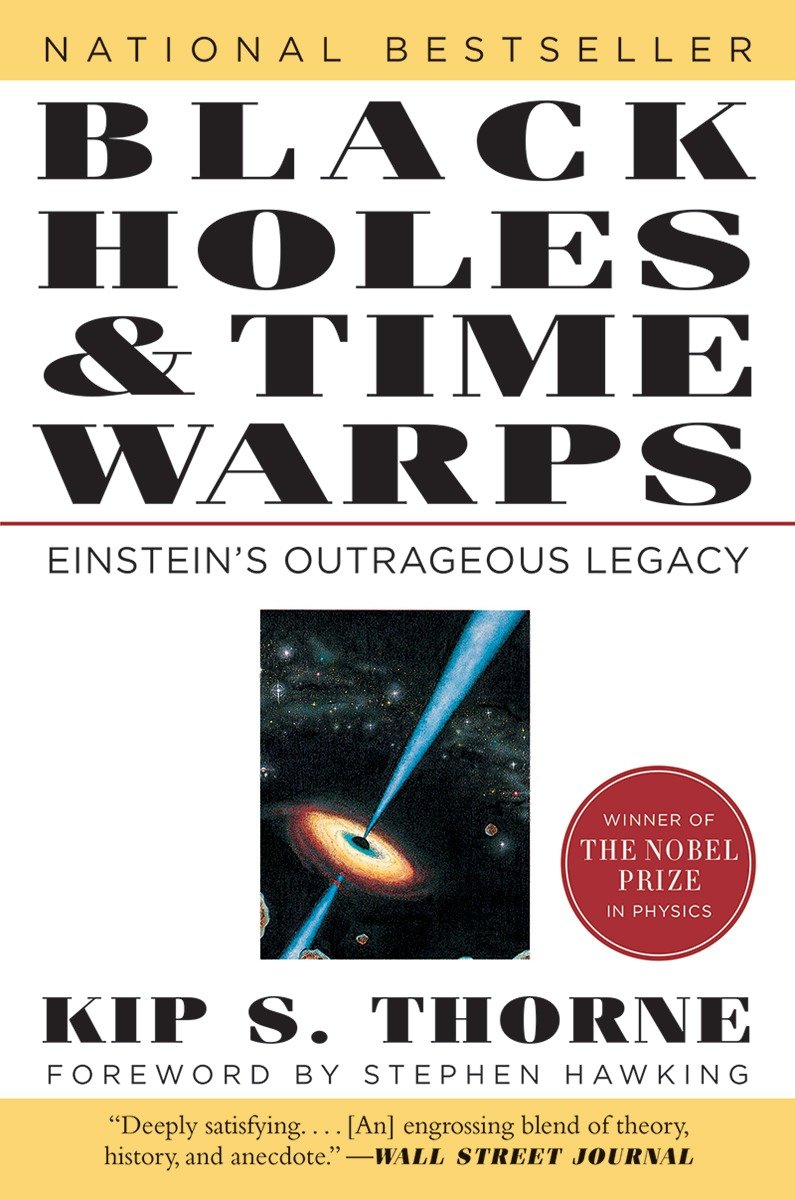
Explore the unsettling possibilities of relativity through scientific explanation and human history.
- Themes
- Relativity and cosmic phenomena, History of theoretical physics, How physicists build knowledge
- Pacing
- Steady
Relativity’s Strange Reach
Come here for
- Black holes, wormholes, and the physics behind their possibility
- Physicists wrestling with Einstein’s legacy
Expect
- A slower-paced, mind-stretching read
- Interlocking scientific ideas woven with human history
Where it sits
- 79%Relativity
- 50%Cosmology
- 40%Astrophysics
How strongly BookFrontier reads the book as belonging to each subject.
Nearest books
Matched by our semantic model. Ordered by what its readers also loved.
 One Two Three . . . InfinityGeorge Gamow62% subject match
 From Eternity to HereSean Carroll75% subject matchShares Cosmology
 The Road to RealityRoger Penrose67% subject matchShares Relativity and Cosmology
 The Demon-Haunted WorldCarl Sagan, Ann Druyan57% subject match
 The Beak of the FinchJonathan Weiner52% subject match
 The Science of InterstellarKip Thorne57% subject matchShares Astrophysics
 The Big PictureSean Carroll67% subject matchShares Cosmology
For younger readers: The Story of Science: Newton at the Center, A Quantum Life, Astrophysics for Young People in a Hurry
Start with three books, and this one can be the first.
Members get a new edition every morning: a route out from their books to essays, research and talks, with the reason for each.
Sign upAbout this book
Winner of the 2017 Nobel Prize in Physics
Ever since Albert Einstein's general theory of relativity burst upon the world in 1915 some of the most brilliant minds of our century have sought to decipher the mysteries bequeathed by that theory, a legacy so unthinkable in some respects that even Einstein himself rejected them.
Which of these bizarre phenomena, if any, can really exist in our universe?
Continue reading
Black holes, down which anything can fall but from which nothing can return; wormholes, short spacewarps connecting regions of the cosmos; singularities, where space and time are so violently warped that time ceases to exist and space becomes a kind of foam; gravitational waves, which carry symphonic accounts of collisions of black holes billions of years ago; and time machines, for traveling backward and forward in time.
Kip Thorne, along with fellow theorists Stephen Hawking and Roger Penrose, a cadre of Russians, and earlier scientists such as Oppenheimer, Wheeler and Chandrasekhar, has been in the thick of the quest to secure answers. In this masterfully written and brilliantly informed work of scientific history and explanation, Dr. Thorne, a Nobel Prize-winning physicist and the Feynman Professor of Theoretical Physics Emeritus at Caltech, leads his readers through an elegant, always human, tapestry of interlocking themes, coming finally to a uniquely informed answer to the great question: what principles control our universe and why do physicists think they know the things they think they know? Stephen Hawking's A Brief History of Time has been one of the greatest best-sellers in publishing history. Anyone who struggled with that book will find here a more slowly paced but equally mind-stretching experience, with the added fascination of a rich historical and human component.
Winner of the Phi Beta Kappa Award in Science.
Publisher details
Publisher categories
- Relativity
- Authors
- Kip S Thorne
- Publisher
- WW Norton
- Published
- March 7, 1995
- Format
- Print & ebook
- Reading lane
- Relativity