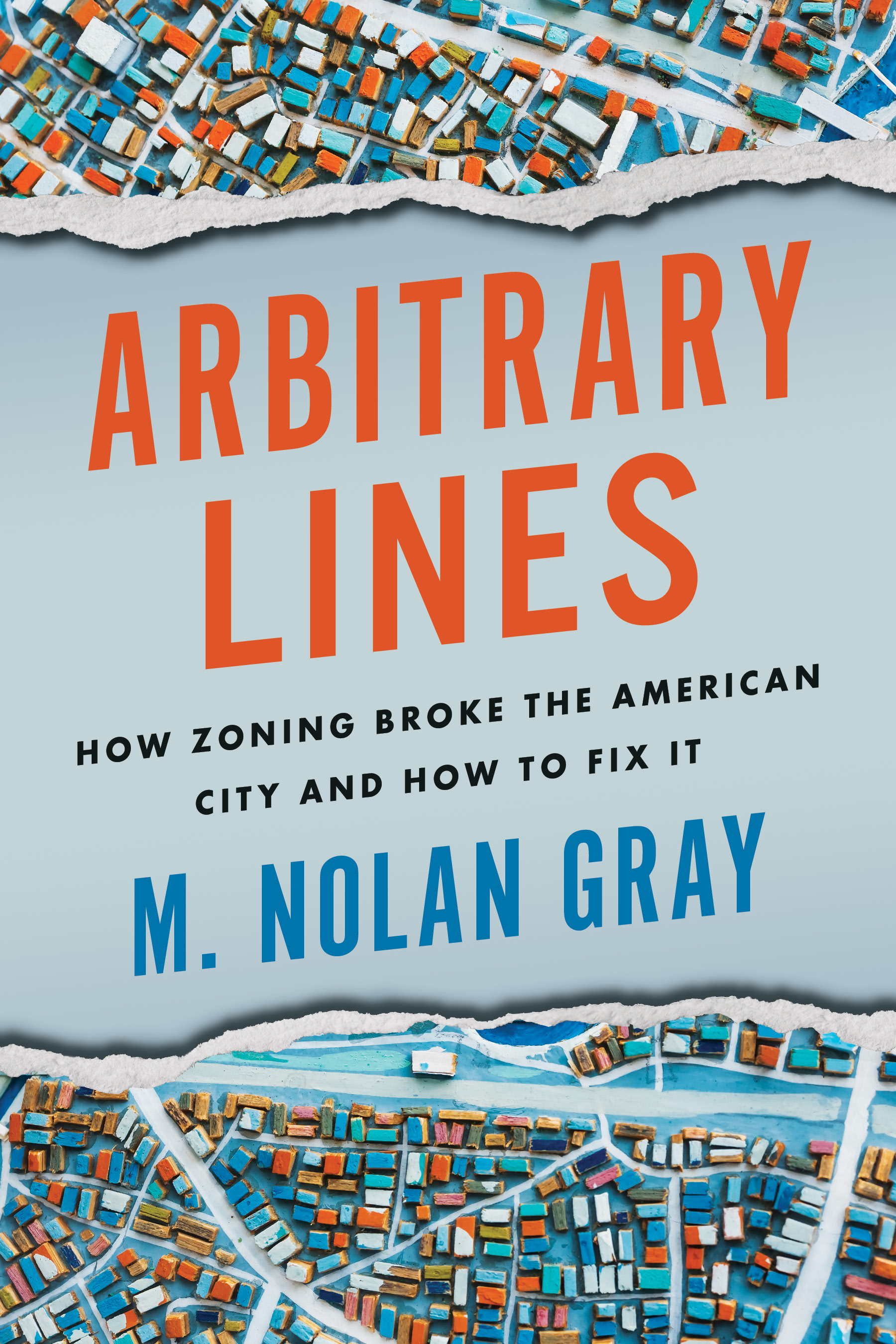
Arbitrary Lines
How Zoning Broke the American City and How to Fix It
A serious, accessible guide to how zoning shapes cities—and why that matters.
Why It Clicks
Come here for
- zoning, cities, and local government
- clear-eyed explanation with a practical edge
Expect
- straightforward policy-minded framing
- usable insight for reference or long reading
Where it sits
How strongly BookFrontier reads the book as belonging to each subject.
Nearest books
Matched by our semantic model. Ordered by what its readers also loved. Most of these share its genre: Cities & Urban Planning.
 StuckYoni Appelbaum65% subject match
 Survival of the CityEdward Glaeser, David Cutler61% subject match
 Glass HouseBrian Alexander44% subject match
For younger readers: Rad American History A-Z, Fault Lines in the Constitution, The Cities of the Future
Start with three books, and this one can be the first.
Members get a new edition every morning: a route out from their books to essays, research and talks, with the reason for each.
Sign upAbout this book
What if scrapping one flawed policy could bring US cities closer to addressing debilitating housing shortages, stunted growth and innovation, persistent racial and economic segregation, and car-dependent development?
It’s time for America to move beyond zoning, argues city planner M. Nolan Gray in Arbitrary Lines: How Zoning Broke the American City and How to Fix It.
Continue reading
With lively explanations and stories, Gray shows why zoning abolition is a necessary—if not sufficient—condition for building more affordable, vibrant, equitable, and sustainable cities.
The arbitrary lines of zoning maps across the country have come to dictate where Americans may live and work, forcing cities into a pattern of growth that is segregated and sprawling.
The good news is that it doesn’t have to be this way. Reform is in the air, with cities and states across the country critically reevaluating zoning. In cities as diverse as Minneapolis, Fayetteville, and Hartford, the key pillars of zoning are under fire, with apartment bans being scrapped, minimum lot sizes dropping, and off-street parking requirements disappearing altogether. Some American cities—including Houston, America’s fourth-largest city—already make land-use planning work without zoning.
In Arbitrary Lines, Gray lays the groundwork for this ambitious cause by clearing up common confusions and myths about how American cities regulate growth and examining the major contemporary critiques of zoning. Gray sets out some of the efforts currently underway to reform zoning and charts how land-use regulation might work in the post-zoning American city.
Despite mounting interest, no single book has pulled these threads together for a popular audience. In Arbitrary Lines, Gray fills this gap by showing how zoning has failed to address even our most basic concerns about urban growth over the past century, and how we can think about a new way of planning a more affordable, prosperous, equitable, and sustainable American city.
Publisher details
Publisher categories
- Urban & Land Use Planning
- Cities & Urban Planning
- Urban Life
- Authors
- M. Nolan Gray
- Publisher
- Island Press
- Published
- June 21, 2022
- Format
- Print & ebook
- Reading lane
- Urban & Land Use Planning