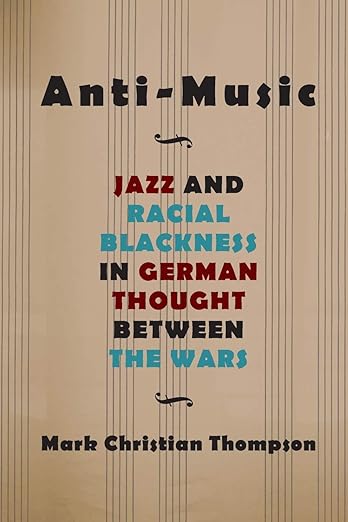
Anti-music
Jazz and Racial Blackness in German Thought Between the Wars
State University of New York Press · Print & ebook · January 2, 2019
Examines how African American jazz music was received in Germany both as a racial and cultural threat and as a partner in promoting the rise of Nazi totalitarian cultural politics.
We earn from qualifying purchases.
- Who it’s for
- Interwar German debates over jazz reveal shifting links between race, politics, and cultural criticism.
- Genres
- Jazz, Music History, African American Studies
- Published
- State University of New York Press, January 2, 2019
Nearest books
Matched by what the books are about, then ordered by what their readers also loved.
 Beethoven in the BunkerFred Brouwers66% matchShares Music History
 Time's EchoJeremy Eichler57% matchShares Music History
 Hitler's American FriendsBradley W. Hart, Chris Ciulla54% match
 The JazzmenLarry Tye53% matchShares Jazz
 Song Is Not the SameJosh Kun, Bruce Zuckerman52% matchShares Music History
 Germany 1923Volker Ullrich52% match
For younger readers: Facing the Enemy, World War Two: Under the Shadow of the Swastika, Jazz
Start with three books, and this one can be the first.
Members get a new edition every morning: a route out from their books to essays, research and talks, with the reason for each.
Join the waitlistAbout this book
Examines how African American jazz music was received in Germany both as a racial and cultural threat and as a partner in promoting the rise of Nazi totalitarian cultural politics. Anti-Music examines the critical, literary, and political responses to African American jazz music in interwar Germany.
Continue reading
During this time, jazz was the subject of overt political debate between left-wing and right-wing interests: for the left, jazz marked the death knell of authoritarian Prussian society; for the right, jazz was complicit as an American import threatening the chaos of modernization and mass politics. This conflict was resolved in the early 1930s as the left abandoned jazz in the face of Nazi victory, having come to see the music in collusion with the totalitarian culture industry. Mark Christian Thompson recounts the story of this intellectual trajectory and describes how jazz came to be associated with repressive, virulently racist fascism in Germany. By examining writings by Hermann Hesse, Bertolt Brecht, T.W. Adorno, and Klaus Mann, and archival photographs and images, Thompson brings together debates in German, African American, and jazz studies, and charts a new path for addressing antiblack racism in cultural criticism and theory.
Jazz in Interwar Germany
Interwar German debates over jazz reveal shifting links between race, politics, and cultural criticism.
Come here for
- Critical, literary, and political responses to African American jazz
- Archival photographs and images
Expect
- Writings by Hermann Hesse, Bertolt Brecht, T.W. Adorno, and Klaus Mann
- Connections across German, African American, and jazz studies
Where it sits
| Jazz | 65% |
|---|---|
| African American Studies | 37% |
| Music History | 26% |
Percentages are BookFrontier’s reading of the book.
Publisher categories
- German Literary Criticism
- Music History
- Philosophy
- Authors
- Mark Christian Thompson
- Publisher
- State University of New York Press
- Published
- January 2, 2019
- Format
- Print & ebook
- Reading lane
- German Literary Criticism