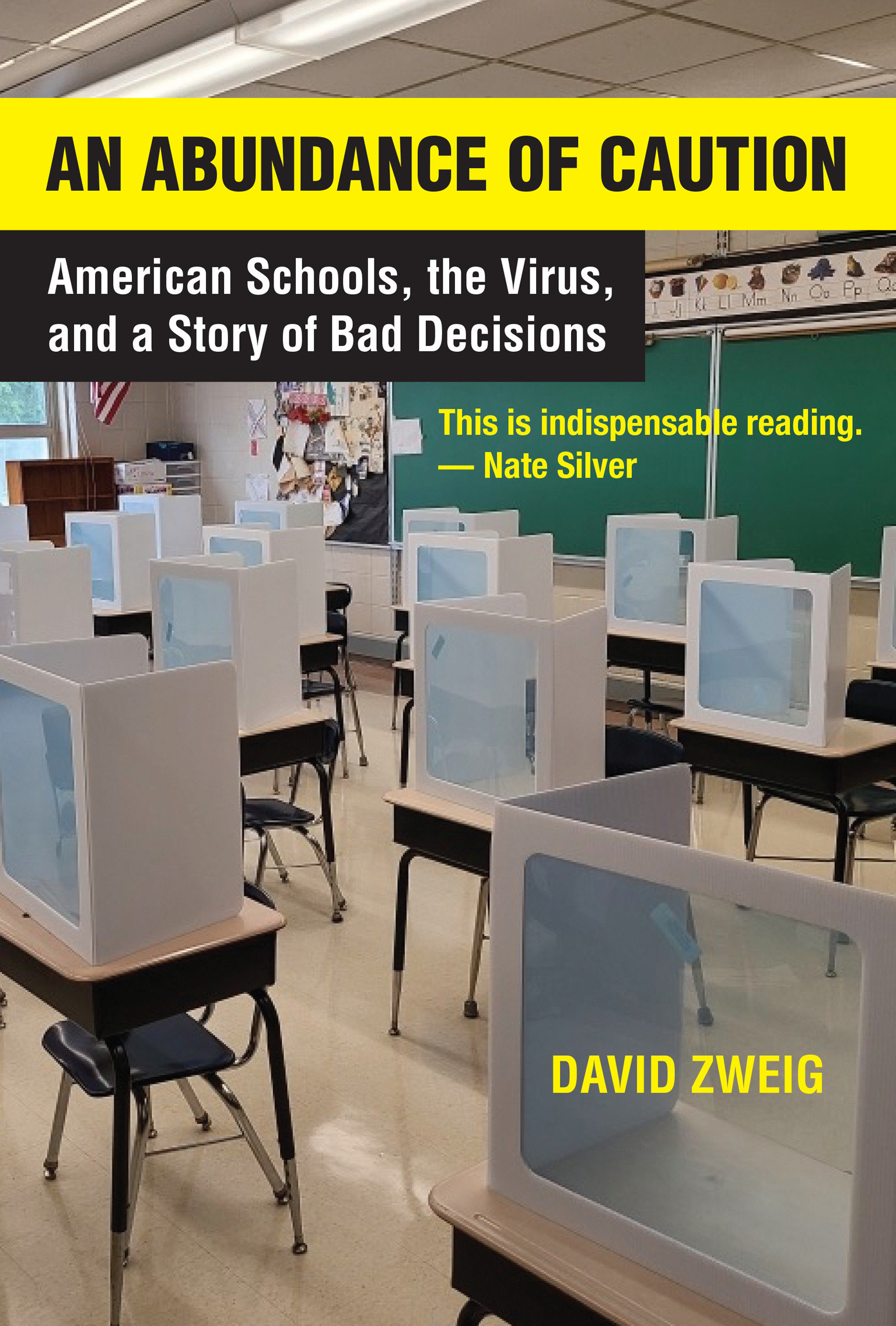
An Abundance of Caution
American Schools, the Virus, and a Story of Bad Decisions
A reported account of school closures probes how institutions make consequential choices under pressure.
- Themes
- Pandemic school closures, Institutional decision-making, Educational inequality
Crisis, Under Scrutiny
Come here for
- A close look at public health, media, and political decision-making
- Questions about evidence, uncertainty, and institutional judgment
Expect
- Meticulously reported scrutiny of pandemic-era school policy
- A broader inquiry into how societies act under duress
Where it sits
How strongly BookFrontier reads the book as belonging to each subject.
Nearest books
Matched by our semantic model. Ordered by what its readers also loved.
 Lies My Liberal Teacher Told MeWilfred Reilly50% subject match
 Follow the ScienceSharyl Attkisson51% subject match
 Lies My Gov't Told MeRobert W. Malone55% subject match
 Random Acts of MedicineAnupam B. Jena, Christopher Worsham50% subject match
 Land of HopeWilfred M. McClay49% subject match
 The PremonitionMichael Lewis66% subject matchShares Health Care Policy
For younger readers: An American Plague, Patient Zero, The Deadliest Diseases Then and Now
Start with three books, and this one can be the first.
Members get a new edition every morning: a route out from their books to essays, research and talks, with the reason for each.
Sign upAbout this book
A searing indictment of the American public health, media, and political establishments’ decision-making process behind pandemic school closures.
An Abundance of Caution is a devastating account of the decision-making process behind one of the worst American policy failures in a century—the extended closures of public schools during the pandemic.
Continue reading
In fascinating and meticulously reported detail, David Zweig shows how some of the most trusted members of society—from Pulitzer Prize–winning journalists to eminent health officials—repeatedly made fundamental errors in their assessment and presentation of evidence. As a result, for the first time in modern American history, millions of healthy children did not set foot in a classroom for more than a year.
Since the spring of 2020, many students in Europe had been learning in person. Even peers at home—in private schools, and public schools in mostly “red” states and districts—were in class full time from fall 2020 onward. Whatever inequities that existed among American children before the pandemic, the selective school closures exacerbated them, disproportionately affecting the underprivileged. Deep mental, physical, and academic harms—among them, depression, anxiety, abuse, obesity, plummeting test scores, and rising drop-out rates—were endured for no discernible benefit. As Europe had shown very early, after they had sent kids back to class, there was never any evidence that long-term school closures, nor a host of interventions imposed on students when they were in classrooms, would reduce overall cases or deaths in any meaningful way.
The story of American schools during the pandemic serves as a prism through which to approach fundamental questions about why and how individuals, bureaucracies, governments, and societies act as they do in times of crisis and uncertainty. Ultimately, this book is not about COVID; it’s about a country ill-equipped to act sensibly under duress.
Publisher details
Publisher categories
- Federal Education Policy
- Health Care Policy
- How Media Works
- Authors
- David Zweig
- Publisher
- MIT Press
- Published
- April 22, 2025
- Format
- Print & ebook
- Reading lane
- Federal Education Policy