
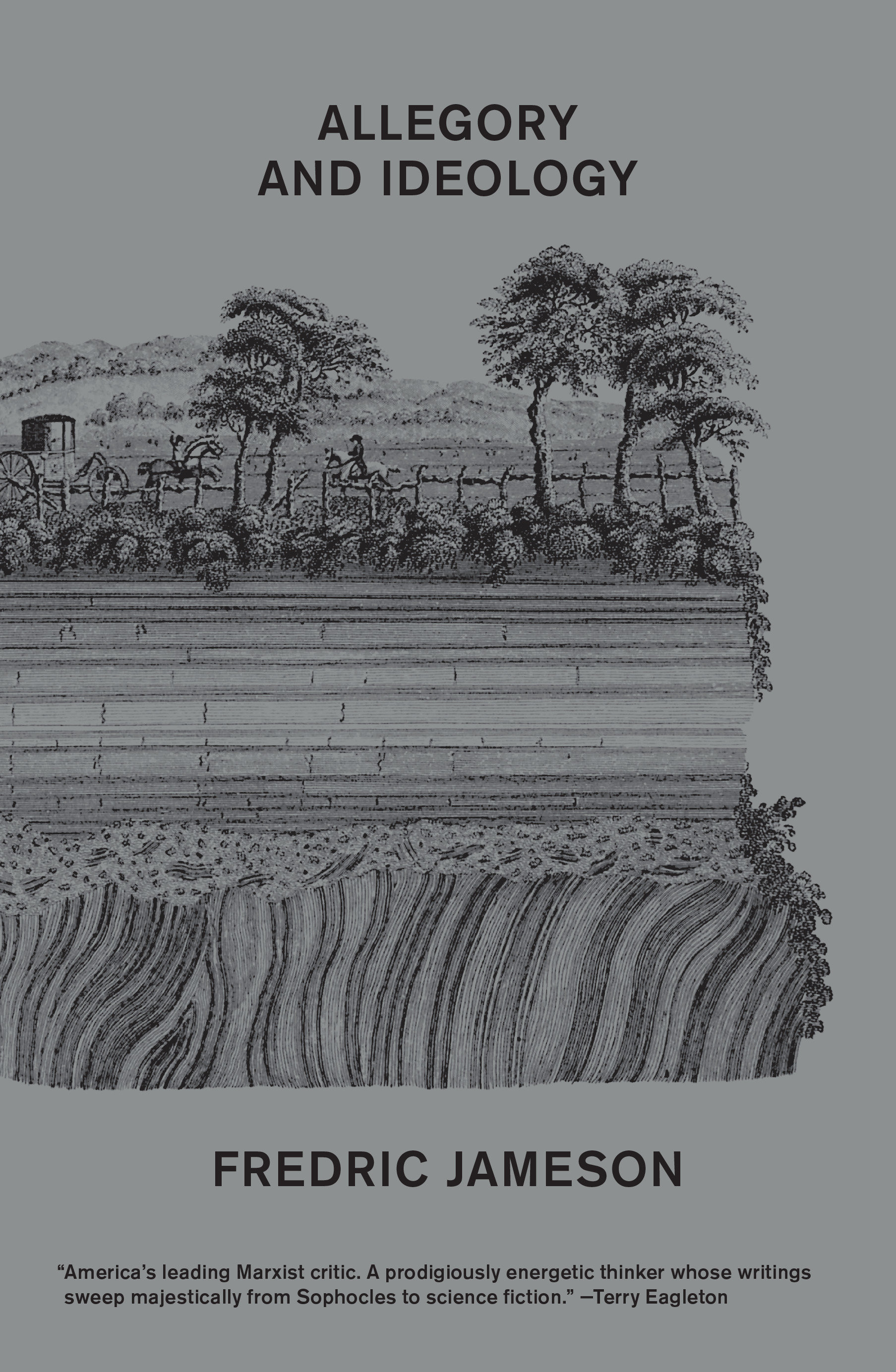
Book
Allegory and Ideology
Fredric Jameson
Verso Books · Paperback · November 17, 2020
Reading lane: Politics in Literature
Fredric Jameson takes on the allegorical form Works do not have meanings, they soak up meanings: a work is a machine for libidinal investments (including the political kind).
At a Glance
Who It's For
Book Details
- Authors
- Fredric Jameson
- Publisher
- Verso Books
- Published
- November 17, 2020
- Format
- Paperback
- Theme
- Politics in Literature · 21st Century Literature
- Reading lane
- Politics in Literature
Affinity
Publisher Categories
21st Century Literature
Politics in Literature
Comparative Politics
About This Book
Fredric Jameson takes on the allegorical form Works do not have meanings, they soak up meanings: a work is a machine for libidinal investments (including the political kind). It is a process that sorts incommensurabilities and registers contradictions (which is not the same as solving them!) The inevitable and welcome conflict of interpretations - a discursive, ideological struggle - therefore needs to be supplemented by an account of this simultaneous processing of multiple...
Read full description
Similar Books

The Antinomies of Realism
Fredric Jameson · Verso Books
Affinity signal
19th-Century Literary Criticism
Politics in Literature

Postmodernism, Or, the Cultural Logic of Late Capitalism
Fredric Jameson · Duke University Press
Affinity signal
Politics in Literature
21st Century Literature
The Democratic Paradox
Chantal Mouffe · Verso Books
Affinity signal
Radical Politics
Anarchism

Allegories of the Anthropocene
Elizabeth M. DeLoughrey · Duke University Press
Affinity signal
Nature in Literature
Australian & Pacific Lit Crit
The World, the Text, and the Critic
Edward W. Said · Knopf Doubleday Publishing Group
Affinity signal
20th-Century Literary Criticism
Politics in Literature

The Liberal Imagination
Lionel Trilling, Louis Menand · New York Review Books
Affinity signal
Politics in Literature
20th-Century Literary Criticism

Du Bois's Telegram
Juliana Spahr · WW Norton
Affinity signal
Politics in Literature
21st Century Literature

American Literary Misfits
D. Berton Emerson · The University of North Carolina Press
Affinity signal
American Lit Crit
Politics in Literature