
A Tragedy of Democracy
Japanese Confinement in North America
Where it sits
How strongly BookFrontier reads the book as belonging to each subject.
Nearest books
Matched by our semantic model. Ordered by what its readers also loved.
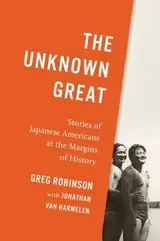 The Unknown GreatGreg Robinson56% subject matchShares Asian American Studies
 Japan's Infamous Unit 731Hal Gold55% subject match
 Factories of DeathSheldon H. Harris55% subject match
 A Plague upon HumanityDaniel Barenblatt54% subject match
 A Fate Worse than HellW. Fitzhugh Brundage53% subject match
 A River in DarknessMasaji Ishikawa52% subject match
 Ending IsolationChristopher William Blackwell, Deborah Zalesne52% subject matchShares Civil Rights
For younger readers: Days of Infamy: How a Century of Bigotry Led to Japanese American Internment, When Can We Go Back to America?, Farewell to Manzanar
Start with three books, and this one can be the first.
Members get a new edition every morning: a route out from their books to essays, research and talks, with the reason for each.
Sign upAbout this book
The confinement of some 120,000 Japanese Americans during World War II, often called the Japanese American internment, has been described as the worst official civil rights violation of modern U. S. history. Greg Robinson not only offers a bold new understanding of these events but also studies them within a larger time frame and from a transnational perspective.
Continue reading
Drawing on newly discovered material, Robinson provides a backstory of confinement that reveals for the first time the extent of the American government's surveillance of Japanese communities in the years leading up to war and the construction of what officials termed "concentration camps" for enemy aliens. He also considers the aftermath of confinement, including the place of Japanese Americans in postwar civil rights struggles, the long movement by former camp inmates for redress, and the continuing role of the camps as touchstones for nationwide commemoration and debate.
Most remarkably, A Tragedy of Democracy is the first book to analyze official policy toward West Coast Japanese Americans within a North American context. Robinson studies confinement on the mainland alongside events in wartime Hawaii, where fears of Japanese Americans justified Army dictatorship, suspension of the Constitution, and the imposition of military tribunals. He similarly reads the treatment of Japanese Americans against Canada's confinement of 22,000 citizens and residents of Japanese ancestry from British Columbia. A Tragedy of Democracy recounts the expulsion of almost 5,000 Japanese from Mexico's Pacific Coast and the poignant story of the Japanese Latin Americans who were kidnapped from their homes and interned in the United States. Approaching Japanese confinement as a continental and international phenomenon, Robinson offers a truly kaleidoscopic understanding of its genesis and outcomes.
The confinement of some 120,000 Japanese Americans during World War II, often called the Japanese American internment, has been described as the worst official civil rights violation of modern U. S. history. Greg Robinson not only offers a bold new understanding of these events but also studies them within a larger time frame and from a transnational perspective. Drawing on newly discovered material, Robinson provides a backstory of confinement that reveals for the first time the extent of the American government's surveillance of Japanese communities in the years leading up to war and the construction of what officials termed "concentration camps" for enemy aliens. He also considers the aftermath of confinement, including the place of Japanese Americans in postwar civil rights struggles, the long movement by former camp inmates for redress, and the continuing role of the camps as touchstones for nationwide commemoration and debate. Most remarkably, A Tragedy of Democracy is the first book to analyze official policy toward West Coast Japanese Americans within a North American context. Robinson studies confinement on the mainland alongside events in wartime Hawaii, where fears of Japanese Americans justified Army dictatorship, suspension of the Constitution, and the imposition of military tribunals. He similarly reads the treatment of Japanese Americans against Canada's confinement of 22,000 citizens and residents of Japanese ancestry from British Columbia. A Tragedy of Democracy recounts the expulsion of almost 5,000 Japanese from Mexico's Pacific Coast and the poignant story of the Japanese Latin Americans who were kidnapped from their homes and interned in the United States. Approaching Japanese confinement as a continental and international phenomenon, Robinson offers a truly kaleidoscopic understanding of its genesis and outcomes.
Publisher details
Publisher categories
- World War II History
- 20th-Century America
- Civil Rights
- Human Rights
Show all 5 publisher categories
- Asian American Studies
- Authors
- Greg Robinson
- Publisher
- Columbia University Press
- Published
- June 30, 2009
- Format
- Print & ebook
- Reading lane
- World War II History