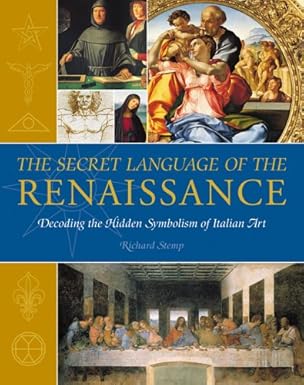
The Secret Language of the Renaissance
Decoding the Hidden Symbolism of Italian Art
Duncan Baird · Print & ebook · October 28, 2006
During the Renaissance, artists traditionally encoded meanings into symbols, some of which drew upon a traditional repertoire available to educated people in the era.
We earn from qualifying purchases.
- Genres
- Renaissance Art History, Renaissance History, Renaissance Architecture
- Published
- Duncan Baird, October 28, 2006
Nearest books
Matched by what the books are about, then ordered by what their readers also loved. Most of these share its genres: Renaissance Art History and Renaissance History.
 Caravaggio. the Complete WorksSebastian Schütze48% match
 Oil and MarbleStephanie Storey55% match
 Leonardo and the Last SupperRoss King51% match
 Botticelli's SecretJoseph Luzzi63% match
 Studies in IconologyErwin Panofsky, Gerda S. Panofsky62% match
 Pagan Mysteries in the RenaissanceEdgar Wind61% match
 Renaissance Art ReconsideredCarol M. Richardson, Kim W. Woods61% match
 The Oxford Illustrated History of the RenaissanceGordon Campbell60% match
For younger readers: Who Was Michelangelo?, The Second Mrs. Gioconda, Renaissance Fashions Coloring Book
Start with three books, and this one can be the first.
Members get a new edition every morning: a route out from their books to essays, research and talks, with the reason for each.
Join the waitlistAbout this book
During the Renaissance, artists traditionally encoded meanings into symbols, some of which drew upon a traditional repertoire available to educated people in the era. These hidden messages?which ranged from the esoteric to the political to the religious?could be communicated in everything from the position of a hand to the placement of the sun and moon.
Continue reading
The Secret Language of the Renaissance helps us discover them anew, as lecturer, author, and director Richard Stemp teaches you the art of reading these paintings. Magnificently illustrated throughout, and with a six-color gold-foil cover, this remarkable book has three distinct parts. The first surveys the literature, painting, sculpture, architecture, and decorative arts of this remarkable period. Section two reviews the essential elements of symbolic Language in Renaissance art, including the use of color, geometry, light and shade, composition, proportion, perspective, and body Language; the explanatory examples reach from Crivelli’s Annunciation to Donatello’s Mary Magdalene. And the final part features themes including Mythology, War and Peace, and Death and Eternity.
Where it sits
| Renaissance Art History | 95% |
|---|---|
| Renaissance History | 55% |
| Renaissance Architecture | 20% |
Percentages are BookFrontier’s reading of the book.
Publisher categories
- Renaissance Art History
- Authors
- Richard Stemp
- Publisher
- Duncan Baird
- Published
- October 28, 2006
- Format
- Print & ebook
- Reading lane
- Renaissance Art History