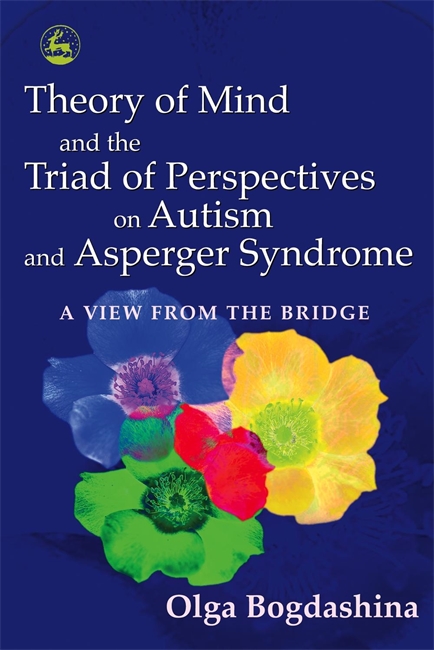
Theory of Mind and the Triad of Perspectives on Autism and Asperger Syndrome
A View From the Bridge
Jessica Kingsley Publishers · Print & ebook · October 15, 2005
Inspired by the often uncomfortable interplay between autistic individuals, parents and professionals in understanding autistic spectrum conditions, Olga Bogdashina uses the concept of Theory of Mind (ToM) to consider these groups' different (and often conflicting) perspectives.
We earn from qualifying purchases.
- Who it’s for
- It compares autistic, parental, and professional perspectives on autism across key questions.
- Genres
- Autism Spectrum, How We Think & Learn
- Published
- Jessica Kingsley Publishers, October 15, 2005
Nearest books
Matched by what the books are about, then ordered by what their readers also loved. Most of these share its genre: Autism Spectrum.
 Life on the BridgeKaelynn Partlow66% match
 Magnificent MindsSuzanne Goh MD63% match
 The Autistic BrainTemple Grandin, Richard Panek62% match
 Connecting With the Autism SpectrumCasey "Remrov" Vormer62% match
 NeurotribesSteve Silberman, Oliver Sacks61% match
 Navigating AutismTemple Grandin, Debra Moore60% match
 Uniquely Human: Updated and ExpandedBarry M. Prizant Ph.D., Tom Fields-Meyer60% match
 Autism and Asperger Syndrome in AdultsLuke Beardon60% match
For younger readers: The Awesome Autistic Go-to Guide, The Asperkid's (secret) Book of Social Rules, 10th Anniversary Edition, The Survival Guide for Kids With Autism Spectrum Disorder (and Their Parents)
Start with three books, and this one can be the first.
Members get a new edition every morning: a route out from their books to essays, research and talks, with the reason for each.
Join the waitlistAbout this book
Inspired by the often uncomfortable interplay between autistic individuals, parents and professionals in understanding autistic spectrum conditions, Olga Bogdashina uses the concept of Theory of Mind (ToM) to consider these groups' different (and often conflicting) perspectives. ToM is the ability to imagine and make judgements about what others feel and think; its absence in autistic individuals is called 'mindblindness'.
Continue reading
This book addresses the 'mindblindness' of people united in their interest in autism but divided by their different angles and perspectives. Divided into four parts, the book first defines autism, then the views of the three main groups working with it - autistic individuals, parents and professionals - under the headings of classifications, diagnosis, causes, development, theories and treatment. By comparing and reconciling the different perspectives in this way, the book helps each group to understand and predict each other's responses and behaviours. This enlightening and innovative book offers a unique way of 'stepping in each other's shoes' and is a valuable resource for all people living or working with autism.
Three Autism Perspectives
It compares autistic, parental, and professional perspectives on autism across key questions.
Come here for
- Different perspectives on classifications
- Different perspectives on diagnosis
Expect
- A first part defining autism
- Views from autistic individuals, parents, and professionals
Where it sits
| Autism Spectrum | 91% |
|---|---|
| How We Think & Learn | 17% |
Percentages are BookFrontier’s reading of the book.
Publisher categories
- Communication Disorders
- Intellectual & Developmental Disabilities
- How We Think & Learn
- Authors
- Olga Bogdashina
- Publisher
- Jessica Kingsley Publishers
- Published
- October 15, 2005
- Format
- Print & ebook
- Reading lane
- Communication Disorders