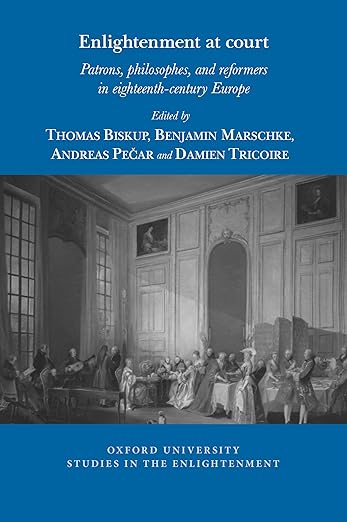
Enlightenment at Court
Patrons, Philosophes, and Reformers in Eighteenth-century Europe
Liverpool University Press · Print & ebook · August 8, 2022
This is the first comprehensive analysis of the royal and princely courts of Europe as important places of Enlightenment.
We earn from qualifying purchases.
- Who it’s for
- Essays trace how European courts shaped Enlightenment writing, careers, public images, and reform.
- Genres
- 18th-Century History, 18th Century Literature, French History
- Published
- Liverpool University Press, August 8, 2022
Nearest books
Matched by what the books are about, then ordered by what their readers also loved.
 The Books That Made the European EnlightenmentGary Kates, Beat Kümin62% matchShares 18th-Century History and 18th Century Literature
 Europe 1600-1789Anthony F. Upton53% matchShares 18th-Century History and French History
 All Things GeorgianJoanne Major, Sarah Murden53% matchShares 18th-Century History
 Europe in the Sixteenth CenturyH.G. Koenigsberger, George L. Mosse51% match
 Louis XIVJosephine Wilkinson51% matchShares French History
 The Seventeenth CenturyJoseph Bergin50% match
 Francis ILeonie Frieda50% matchShares French History
 Game of QueensSarah Gristwood48% match
For younger readers: The Book of Kings, Queen Eleanor, The Renaissance Thinkers
Start with three books, and this one can be the first.
Members get a new edition every morning: a route out from their books to essays, research and talks, with the reason for each.
Join the waitlistAbout this book
This is the first comprehensive analysis of the royal and princely courts of Europe as important places of Enlightenment. The households of European rulers remained central to politics and culture throughout the eighteenth century, and few writers, artists, musicians, or scholars could succeed without establishing connections to ruling houses, noble families, or powerful courtiers.
Continue reading
Covering case studies from Spain and France to Russia, and from Scandinavia and Britain to the Holy Roman Empire, the contributions of this volume examine how Enlightenment figures were integrated into the princely courts of the Ancien Régime , and what kinds of relationships they had with courtiers. Dangers and opportunities presented by proximity to court are discussed as well as the question of what rulers and courtiers gained from their interactions with Enlightenment men and women of letters. The book focusses on four areas: firstly, the impact of courtly patronage on Enlightenment discourses and the work as well as careers of Enlightenment writers; secondly, the court as an audience to be catered for by Enlightenment writers; thirdly, the function of Enlightenment narratives and discourses for the image-making of rulers and courtiers; and fourthly, the role the interaction of courtiers and Enlightenment writers played for the formulation of reform policies.
Courtly Patronage
Essays trace how European courts shaped Enlightenment writing, careers, public images, and reform.
Come here for
- Courtly patronage and writers’ careers
- Courts as audiences for Enlightenment writing
Expect
- The dangers and opportunities of proximity to court
- Interactions between courtiers and writers in reform policy
Where it sits
| 18th-Century History | 93% |
|---|---|
| 18th Century Literature | 67% |
| French History | 38% |
Percentages are BookFrontier’s reading of the book.
Publisher categories
- 18th-Century History
- Authors
- Thomas Biskup, Benjamin Marschke, Andreas Pečar
- Publisher
- Liverpool University Press
- Published
- August 8, 2022
- Format
- Print & ebook
- Reading lane
- 18th-Century History