

Book
The Rise and Fall of the Second American Republic
Reconstruction, 1860-1920
Manisha Sinha
WW Norton · Print & ebook · March 26, 2024
Reading lane: 19th-Century America
"Sinha not only has taken on this vast subject, but has greatly expanded its definition, both temporally and spatially. . . .
At a Glance
Why This Clicks
Democracy in Wider Frame
A sweeping history connects Reconstruction to struggles over democracy across a changing nation.
Come here for
- See Reconstruction linked to labor, suffrage, immigration, and Indigenous rights.
- Follow the era from Lincoln’s election to the Nineteenth Amendment.
Expect
- A broad, connected account of American history from 1860 to 1920.
- A clear-eyed look at democracy’s advances, reversals, and fragility.
Book Details
- Authors
- Manisha Sinha
- Publisher
- WW Norton
- Published
- March 26, 2024
- Format
- Print & ebook
- Theme
- 19th-Century America · Civil War Era
- Reading lane
- 19th-Century America
Affinity
Publisher Categories
19th-Century America
Civil War Era
Slavery Studies
About This Book
"Sinha not only has taken on this vast subject, but has greatly expanded its definition, both temporally and spatially. . . . She covers these difficult issues with remarkable skill and clarity." —S. C. Gwynne, New York Times Book Review We are told that the present moment bears a strong resemblance to Reconstruction, the era after the Civil War when the victorious North attempted to create an interracial democracy in the unrepentant South. That effort failed—and that failur...
Read full description
Similar Books

The Second Founding
Eric Foner · WW Norton
Affinity signal
Civil War Era
Revolutionary America (1775-1800)

The Republic for Which It Stands
Richard White, Noah Michael Levine · Oxford University Press
Affinity signal
19th-Century America
Civil War Era
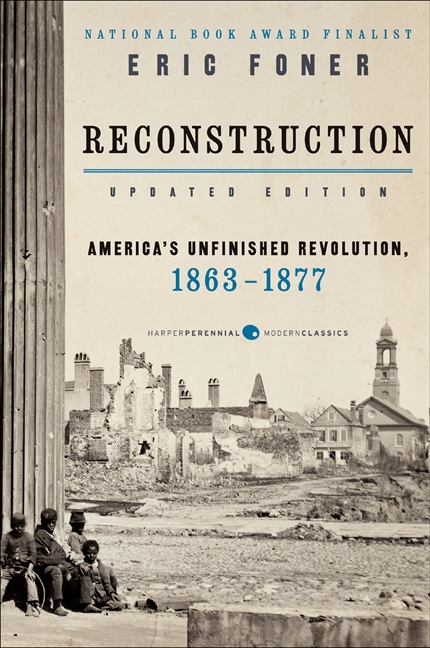
Reconstruction Updated Edition
Eric Foner · HarperCollins
Affinity signal
Civil War Era
19th-Century America
![A Short History of Reconstruction [updated Edition] by Eric Foner](https://img.bookfrontier.com/9780062370860.jpg?v=79962d69ffa095fa)
A Short History of Reconstruction [updated Edition]
Eric Foner · HarperCollins
Affinity signal
Civil War Era
19th-Century America

American Visions
Edward L. Ayers · WW Norton
Affinity signal
19th-Century America
Revolutionary America (1775-1800)

The American Revolution
Gordon S. Wood · Random House Publishing Group
Affinity signal
Revolutionary America (1775-1800)
Colonial America (to 1775)

By the Light of Burning Dreams
David Talbot, Margaret Talbot · HarperCollins
Affinity signal
Radical Politics
20th-Century America