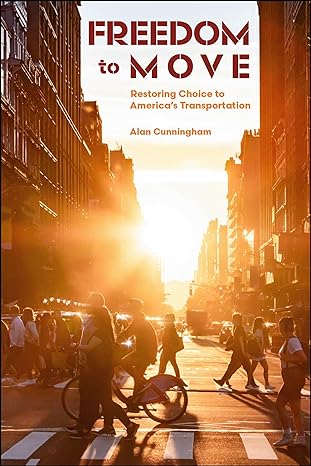
Freedom to Move
Restoring Choice to America's Transportation
Purdue University Press · Print & ebook · March 15, 2026
What if transit stations enabled land use for the sake of walkability and bikeability as much as parking lots dictate land use for the sake of traffic?
We earn from qualifying purchases.
- Who it’s for
- A history of car-centered American development opens onto alternatives around rail stations.
- Genres
- Cities & Urban Planning, Public Transit, Urban & Land Use Planning
- Published
- Purdue University Press, March 15, 2026
Nearest books
Matched by what the books are about, then ordered by what their readers also loved. Most of these share its genres: Cities & Urban Planning and Urban & Land Use Planning.
 Shifting GearsSusan Handy67% match
 Confessions of a Recovering EngineerCharles L. Marohn Jr.63% match
 Transportation for Livable CitiesVukan Vuchic62% matchAlso shares Public Transit
 Inclusive TransportationVeronica Davis, tamika l. butler60% match
 Walkable CityJeff Speck60% match
 Roadways for PeopleLynn Peterson, Elizabeth Doerr60% match
 Door to DoorEdward Humes59% match
 City LimitsMegan Kimble57% match
For younger readers: Pedal Power, Transportation!, The Cities of the Future
Start with three books, and this one can be the first.
Members get a new edition every morning: a route out from their books to essays, research and talks, with the reason for each.
Join the waitlistAbout this book
What if transit stations enabled land use for the sake of walkability and bikeability as much as parking lots dictate land use for the sake of traffic? For over a century, the United States has been devoted to traffic as the predominant mode of transportation. We live further apart, personal vehicles have become expensive obligations, and the availability of parking and traffic flow is an essential concern in urban development.
Continue reading
Freedom to Move tells the engaging history of how we got here. While acknowledging our current reality, this book asks how we can improve it. By redeveloping land use within a three-mile bikeable radius of existing rail transit stations, we could realize immense improvements to safety, fitness, affordability, water and air quality, public health, and real estate markets. The author uses data to argue for freedom of choice?how we can move beyond the inevitability of car dependence, and how that benefits all of us.
Rail Station Land Use
A history of car-centered American development opens onto alternatives around rail stations.
Come here for
- A history of traffic-centered transportation in the United States
- A proposal for bikeable development around existing rail stations
Expect
- An argument for more transportation choice, grounded in data
- Potential benefits including safety, fitness, affordability, and cleaner air and water
Where it sits
| Urban & Land Use Planning | 51% |
|---|---|
| Cities & Urban Planning | 49% |
| Public Transit | 35% |
Percentages are BookFrontier’s reading of the book.
Publisher categories
- Cities & Urban Planning
- Transport Engineering
- Public Transit
- Authors
- Alan Cunningham
- Publisher
- Purdue University Press
- Published
- March 15, 2026
- Format
- Print & ebook
- Reading lane
- Cities & Urban Planning