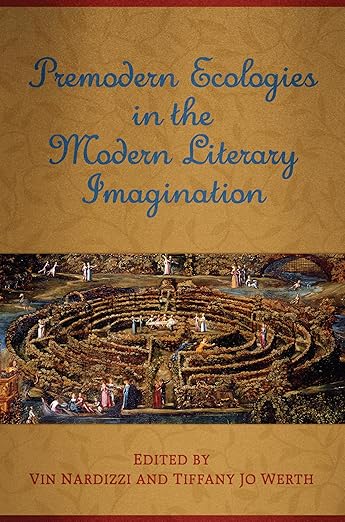
Premodern Ecologies in the Modern Literary Imagination
University of Toronto Press · Print & ebook · April 18, 2019
A discovery pick for readers interested in Premodern Ecologies in the Modern Literary Imagination.
We earn from qualifying purchases.
- Who it’s for
- Essays examine how scholars’ research, writing, and teaching landscapes shape readings of premodern ecologies.
- Genres
- Nature in Literature, Medieval Literary Criticism, Renaissance Literary Criticism
- Published
- University of Toronto Press, April 18, 2019
Nearest books
Matched by what the books are about, then ordered by what their readers also loved. Most of these share its genre: Nature in Literature.
 Postcolonial EcologiesElizabeth DeLoughrey, George B. Handley68% match
 Victorian EcocriticismDewey W. Hall, Julie M. Barst68% match
 Modernism's Inhuman WorldsRasheed Tazudeen65% match
 EcogothicAndrew Smith, William Hughes60% match
 Questioning BordersRobin Visser59% match
 Climate and CrisesBen Holgate57% match
 Landscapes of Writing in Chicano LiteratureImelda Martín-Junquera57% match
 The Ecological PlotJohn MacNeill Miller56% match
Start with three books, and this one can be the first.
Members get a new edition every morning: a route out from their books to essays, research and talks, with the reason for each.
Join the waitlistAbout this book
Premodern Ecologies in the Modern Literary Imagination explores how the cognitive and physical landscapes in which scholars conduct research, write, and teach have shaped their understandings of medieval and Renaissance English literary "oecologies." The collection strives to practice what Ursula K. Heise calls "eco-cosmopolitanism," a method that imagines forms of local environmentalism as a defense against the interventions of open-market global networks.
Continue reading
It also expands the idea’s possibilities and identifies its limitations through critical studies of premodern texts, artefacts, and environmental history. The essays connect real environments and their imaginative (re)creations and affirm the urgency of reorienting humanity’s responsiveness to, and responsibility for, the historical links between human and non-human existence. The discussion of ways in which meditation on scholarly place and time can deepen ecocritical work offers an innovative and engaging approach that will appeal to both ecocritics generally and to medieval and early modern scholars.
Scholarly Place
Essays examine how scholars’ research, writing, and teaching landscapes shape readings of premodern ecologies.
Come here for
- Links real environments with their imaginative recreations
- Critical studies of premodern texts, artefacts, and environmental history
Expect
- Consider how scholarly place and time can deepen ecocritical work
- Explore eco-cosmopolitanism’s possibilities and limitations
Where it sits
| Renaissance Literary Criticism | 79% |
|---|---|
| Nature in Literature | 70% |
| Medieval Literary Criticism | 62% |
Percentages are BookFrontier’s reading of the book.
Publisher categories
- Renaissance Literary Criticism
- 16th-Century Literary Criticism
- 17th-Century Literary Criticism
- Authors
- Vin Nardizzi, Tiffany Jo Werth
- Publisher
- University of Toronto Press
- Published
- April 18, 2019
- Format
- Print & ebook
- Reading lane
- Renaissance Literary Criticism