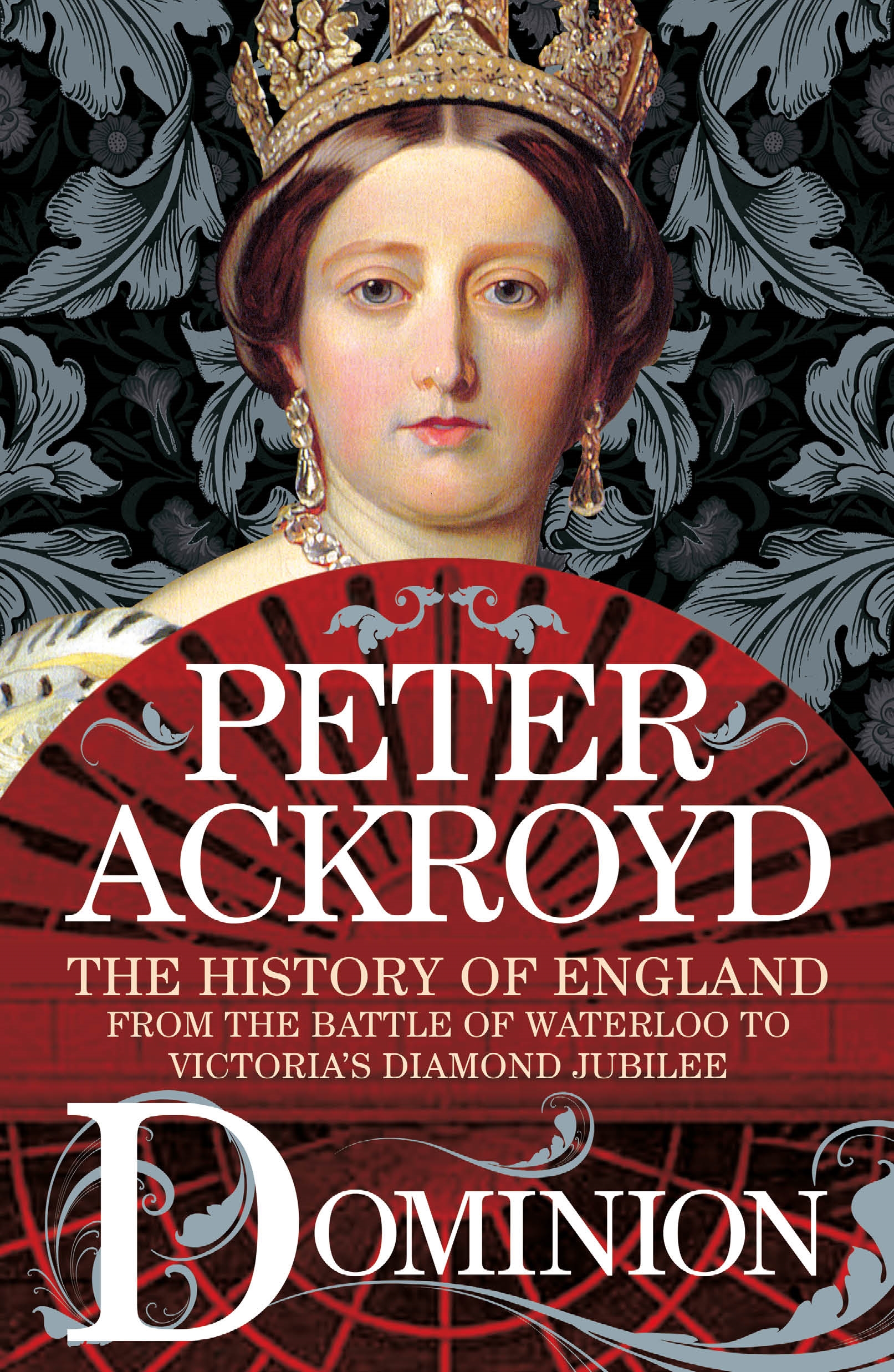
Dominion
The History of England From the Battle of Waterloo to Victoria's Diamond Jubilee
St. Martin's Press · Print & ebook · December 14, 2021
"Ackroyd, as always, is well worth the read." —Kirkus, starred review Dominion, the fifth volume of Peter Ackroyd’s masterful History of England, begins in 1815 as national glory following the Battle of Waterloo gives way to a post-war depression and ends with the death of Queen Victoria in January 1901.
We earn from qualifying purchases.
- Who it’s for
- Follow Britain from Waterloo through political change, industrial upheaval, and the reach of empire.
- Genres
- Victorian Britain (1837-1901), 19th-Century History, Georgian Britain (1714-1837)
- Published
- St. Martin's Press, December 14, 2021
Nearest books
Matched by what the books are about, then ordered by what their readers also loved.
 Victorious CenturyDavid Cannadine, Kris Dyer75% matchShares Victorian Britain (1837-1901) and 19th-Century History
 The Regency YearsRobert Morrison70% matchShares 19th-Century History and Georgian Britain (1714-1837)
 The Anglo-saxonsMarc Morris59% match
 The Blood in WinterJonathan Healey58% match
 The Howe DynastyJulie Flavell52% matchShares Georgian Britain (1714-1837)
 Victorian LondonLiza Picard62% matchShares Victorian Britain (1837-1901) and 19th-Century History
 Queens of the ConquestAlison Weir, Julia Franklin58% match
 Henry VDan Jones58% match
For younger readers: Who Was Queen Victoria?, Victoria Rebels, Who Was Queen Elizabeth II?
Start with three books, and this one can be the first.
Members get a new edition every morning: a route out from their books to essays, research and talks, with the reason for each.
Join the waitlistAbout this book
"Ackroyd, as always, is well worth the read." —Kirkus, starred review Dominion, the fifth volume of Peter Ackroyd’s masterful History of England, begins in 1815 as national glory following the Battle of Waterloo gives way to a post-war depression and ends with the death of Queen Victoria in January 1901.
Continue reading
Spanning the end of the Regency, Ackroyd takes readers from the accession of the profligate George IV whose government was steered by Lord Liverpool, whose face was set against reform, to the ‘Sailor King’ William IV whose reign saw the modernization of the political system and the abolition of slavery. But it was the accession of Queen Victoria, at only eighteen years old, that sparked an era of enormous innovation. Technological progress—from steam railways to the first telegram—swept the nation and the finest inventions were showcased at the first Great Exhibition in 1851. The emergence of the middle-classes changed the shape of society and scientific advances changed the old pieties of the Church of England, and spread secular ideas among the population. Though intense industrialization brought booming times for the factory owners, the working classes were still subjected to poor housing, long work hours, and dire poverty. Yet by the end of Victoria’s reign, the British Empire dominated much of the globe, and Britannia really did seem to rule the waves.
A Century in Motion
Follow Britain from Waterloo through political change, industrial upheaval, and the reach of empire.
Come here for
- The sweep from Regency politics to Victorian railways and telegrams
- A society reshaped by class, science, and reform
Expect
- National ambition alongside factory hardship and working-class poverty
- A broad historical view ending with Victoria’s death in 1901
Where it sits
| Victorian Britain (1837-1901) | 93% |
|---|---|
| Georgian Britain (1714-1837) | 63% |
| 19th-Century History | 60% |
Percentages are BookFrontier’s reading of the book.
Publisher categories
- Georgian Britain (1714-1837)
- Victorian Britain (1837-1901)
- Social History
- Authors
- Peter Ackroyd
- Publisher
- St. Martin's Press
- Published
- December 14, 2021
- Format
- Print & ebook
- Reading lane
- Georgian Britain (1714-1837)