
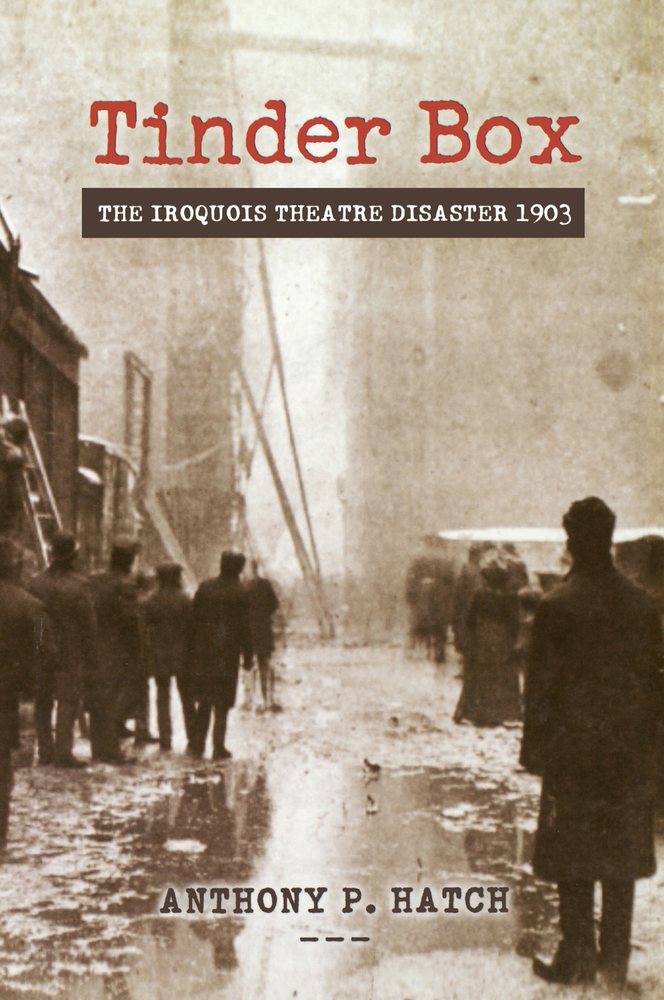
Book
Tinder Box
The Iroquois Theatre Disaster 1903
Anthony P. Hatch
Chicago Review Press · Print & ebook · February 1, 2003
Reading lane: Theater History & Criticism
The Iroquois Theater in Chicago, boasting every modern convenience, advertised itself proudly as “absolutely fireproof” when it opened in November, 1903.
At a Glance
Why This Clicks
Theater’s Darkest Night
A celebrated Chicago theater’s promise of safety gave way to catastrophe and public scandal.
Come here for
- The uneasy intersection of theater history and public safety
- A case where official assurances met glaring failures
Expect
- A devastating fire during a crowded matinee
- Questions of access, oversight, and accountability
Book Details
- Authors
- Anthony P. Hatch
- Publisher
- Chicago Review Press
- Published
- February 1, 2003
- Format
- Print & ebook
- Theme
- Theater History & Criticism · Playwriting
- Reading lane
- Theater History & Criticism
Affinity
Publisher Categories
20th-Century America
Midwest History
Disaster & Crisis Studies
About This Book
The Iroquois Theater in Chicago, boasting every modern convenience, advertised itself proudly as “absolutely fireproof” when it opened in November, 1903. Mr. Bluebeard, a fairy tale musical imported from the Drury Lane Theatre in London was the opening production. And leading the troupe of nearly 400 was one of the most popular comedians of the time, Eddie Foy. None of the many socialites and journalists who flocked to the shows were aware that city building inspectors and o...
Read full description
Similar Books

I Survived the Great Chicago Fire, 1871 (i Survived #11)
Lauren Tarshis · Scholastic Inc.
Affinity signal
21st-Century U.S. Stories
Disasters & Natural Hazards

Tinderbox
Craig Timberg, Daniel Halperin · Penguin Publishing Group
Affinity signal
HIV & AIDS
Infectious Diseases

Showstopper
Lily Anderson · Henry Holt and Co.
Affinity signal
Theater & Musicals for Teens
YA Psychological Thrillers

Show Town
Holly George · University of Oklahoma Press
Affinity signal
Pacific Northwest History
Theater History & Criticism

The Flight 981 Disaster
Samme Chittum · Smithsonian
Affinity signal
Aviation History
Commercial Aviation

No Great Magic
Fritz Leiber · Start Publishing LLC
Affinity signal
Time Travel Fiction
Humorous Fantasy