
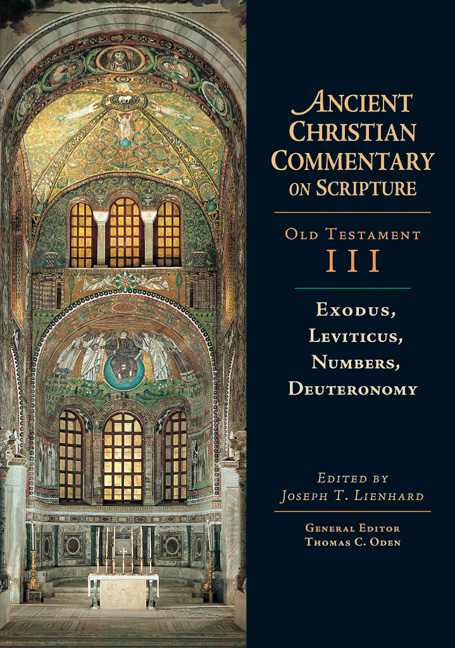
Book
Exodus, Leviticus, Numbers, Deuteronomy
Volume 3
Joseph T. Lienhard, Thomas C. Oden
InterVarsity Press · Print & ebook · August 30, 2001
Reading lane: Pentateuch Commentary
From its inception the church has always had a Bible—the Jewish Scriptures.
At a Glance
Who It's For
Book Details
- Authors
- Joseph T. Lienhard, Thomas C. Oden
- Publisher
- InterVarsity Press
- Published
- August 30, 2001
- Format
- Print & ebook
- Theme
- Pentateuch Commentary · Old Testament Interpretation
- Reading lane
- Pentateuch Commentary
Affinity
Publisher Categories
Pentateuch Commentary
Pentateuch Studies
History of Christian Thought
About This Book
From its inception the church has always had a Bible—the Jewish Scriptures. But Christians have not read these Scriptures in the same way the Jews did. They have read them in the light of what God did in Jesus the Christ. Thus the Jewish Scriptures became for Christian readers the Old Testament. This Ancient Christian Commentary on Scripture volume on Exodus through Deuteronomy bears ample witness to this new way of reading these ancient texts. Among the earliest interpreter...
Read full description
Similar Books

Genesis 1-11
Andrew Louth, Thomas C. Oden · InterVarsity Press
Affinity signal
Pentateuch Commentary
Pentateuch Studies

Numbers
Gordon J. Wenham · InterVarsity Press
Affinity signal
Pentateuch Commentary
Old Testament Interpretation

Proverbs, Ecclesiastes, Song of Solomon
J. Robert Wright, Thomas C. Oden · InterVarsity Press
Affinity signal
Wisdom Literature (Bible)
Old Testament: Poetry & Wisdom

Bible Knowledge Commentary: New Testament
John F. Walvoord, Roy B. Zuck · David C Cook
Affinity signal
Biblical Commentary
Old Testament Commentary

Zondervan Illustrated Bible Backgrounds Commentary Set
Zondervan · Zondervan Academic
Affinity signal
Old Testament Commentary
Old Testament Interpretation

A Guide to Old Testament Theology and Exegesis
Willem A. VanGemeren · Zondervan Academic
Affinity signal
Old Testament Interpretation
Old Testament Studies

Thru the Bible Vol. 07: the Law (leviticus 15-27)
J. Vernon McGee · Thomas Nelson
Affinity signal
Old Testament Interpretation
Old Testament Commentary

Old Testament History
John H. Sailhamer · Zondervan
Affinity signal
Old Testament Studies
Old Testament Interpretation