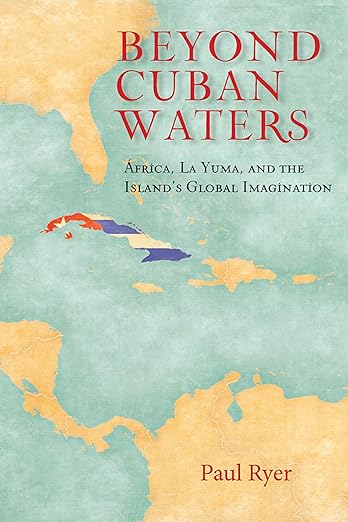
Beyond Cuban Waters
Africa, La Yuma, and the Island's Global Imagination
Vanderbilt University Press · Print & ebook · July 10, 2018
Twenty-first-century Cuba is a cultural stew.
We earn from qualifying purchases.
- Who it’s for
- Paul Ryer examines how Cubans interpret American influence and Africa in everyday cultural life.
- Genres
- How Cultures Work, Cuban History, Caribbean & Latin American Studies
- Published
- Vanderbilt University Press, July 10, 2018
Nearest books
Matched by what the books are about, then ordered by what their readers also loved. Most of these share its genre: Cuban History.
 Cuba in the American ImaginationLouis A. Pérez Jr., Drew Birdseye64% match
 The CubansAnthony DePalma63% match
 Cuban RevelationsMarc Frank63% match
 CubaAntoni Kapcia63% match
 CubaTed A. Henken, Ted Henken60% matchAlso shares Caribbean & Latin American Studies
 On Becoming CubanLouis A. Pérez Jr., Louis A. P?rez60% matchAlso shares Caribbean & Latin American Studies
 The New CubansJean-François Bouchard, Leifheit60% matchAlso shares Caribbean & Latin American Studies
 Antiracism in CubaDevyn Spence Benson59% matchAlso shares Caribbean & Latin American Studies
For younger readers: Leaving Glorytown, Tropical Secrets, The Cat King of Havana
Start with three books, and this one can be the first.
Members get a new edition every morning: a route out from their books to essays, research and talks, with the reason for each.
Join the waitlistAbout this book
Twenty-first-century Cuba is a cultural stew. Tommy Hilfiger and socialism. Nike products and poverty in Africa. The New York Yankees and the meaning of "blackness." The quest for American consumer goods and the struggle in Africa for political and cultural independence inform the daily life of Cubans at every cultural level, as anthropologist Paul Ryer argues in Beyond Cuban Waters.
Continue reading
Focusing on the everyday world of ordinary Cubans, this book examines Cuban understandings of the world and of Cuba's place in it, especially as illuminated by two contrasting notions: "La Yuma," a distinctly Cuban concept of the American experience, and "África," the ideological understanding of that continent's experience. Ryer takes us into the homes of Cuban families, out to the streets and nightlife of bustling cities, and on boat journeys that reach beyond the typical destinations, all to better understand the nature of the cultural life of a nation. This pursuit of Western status symbols represents a uniquely Cuban experience, set apart from other cultures pursuing the same things. In the Cuban case, this represents neither an acceptance nor rejection of the American cultural influence, but rather a co-opting or "Yumanizing" of these influences.
La Yuma and África
Paul Ryer examines how Cubans interpret American influence and Africa in everyday cultural life.
Come here for
- Cuban ideas of “La Yuma” and “África”
- Everyday life in homes, city streets, nightlife, and boat journeys
Expect
- Consumer goods, poverty, and political and cultural independence
- A distinctly Cuban practice of adapting American cultural influences
Where it sits
| Cuban History | 36% |
|---|---|
| How Cultures Work | 36% |
| Caribbean & Latin American Studies | 35% |
Percentages are BookFrontier’s reading of the book.
Publisher categories
- Cuban History
- Pop Culture Studies
- Authors
- Paul Ryer
- Publisher
- Vanderbilt University Press
- Published
- July 10, 2018
- Format
- Print & ebook
- Reading lane
- Cuban History