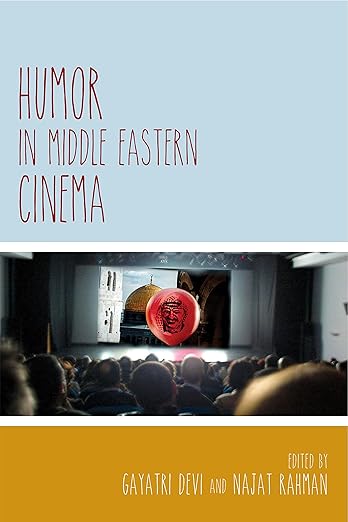
Humor in Middle Eastern Cinema
Kindle Edition
Wayne State University Press · Ebook · January 12, 2014
While Middle Eastern culture does not tend to be associated with laughter and levity in the global imagination, humor?often satirical?has long been a staple of mainstream Arabic film.
We earn from qualifying purchases.
- Who it’s for
- Essays trace satire, irony, absurdity, and other forms of humor across Middle Eastern cinema.
- Genres
- Comedy Films, Film History, Middle Eastern Lit Crit
- Published
- Wayne State University Press, January 12, 2014
Nearest books
Matched by what the books are about, then ordered by what their readers also loved.
 Modern Arabic FictionSalma Khadra Jayyusi55% match
 Modern Arabic DramaSalma Khadra Jayyusi, Roger Allen55% match
 Baghdad Without a Map and Other Misadventures in ArabiaTony Horwitz51% match
 Modern Arab American FictionSteven Salaita51% matchShares Middle Eastern Lit Crit
 Scheherazade's LegacySusan M. Darraj, Susan Muaddi Darraj50% matchShares Middle Eastern Lit Crit
 Cognitive Linguistics and Humor ResearchGeert Brône, Kurt Feyaerts50% match
 Trials of Arab ModernityTarek El-Ariss50% matchShares Middle Eastern Lit Crit
 You Can't Joke About ThatKat Timpf48% match
For younger readers: 19 Varieties of Gazelle, The Middle East, Children's Favorite Arabic Stories
Start with three books, and this one can be the first.
Members get a new edition every morning: a route out from their books to essays, research and talks, with the reason for each.
Join the waitlistAbout this book
While Middle Eastern culture does not tend to be associated with laughter and levity in the global imagination, humor?often satirical?has long been a staple of mainstream Arabic film. In Humor in Middle Eastern Cinema, editors Gayatri Devi and Najat Rahman shed light on this tradition, as well as humor and laughter motivated by other intent?including parody, irony, the absurd, burlesque, and dark comedy.
Continue reading
Contributors trace the proliferation of humor in contemporary Middle Eastern cinema in the works of individual directors and from the perspectives of genre, national cinemas, and diasporic cinema. Humor in Middle Eastern Cinema explores what humor theorists have identified as an "emancipatory," "liberatory," even "revolutionary" function to humor. Among the questions contributors ask are: How does Middle Eastern cinema and media highlight the stakes and place of humor in art and in life? What is its relation to the political? Can humor in cinematic art be emancipatory? What are its limits for its intervention or transformation? Contributors examine the region's masterful auteurs, such as Abbas Kiarostami, Youssef Chahine, and Elia Suleiman and cover a range of cinematic settings, including Egypt, Iran, Israel, Lebanon, Palestine, Syria, Tunisia, and Turkey. They also trace diasporic issues in the distinctive cinema of India and Pakistan. This insightful collection will introduce readers to a variety of contemporary Middle Eastern cinema that has attracted little critical notice. Scholars of cinema and media studies as well as Middle Eastern cultural history will appreciate this introduction to a complex and fascinating cinema.
Middle Eastern Cinema
Essays trace satire, irony, absurdity, and other forms of humor across Middle Eastern cinema.
Come here for
- Satirical humor in mainstream Arabic film
- Dark comedy in Middle Eastern cinema
Expect
- Questions about humor’s relation to politics
- Studies of individual directors
Where it sits
| Comedy Films | 70% |
|---|---|
| Film History | 68% |
| Middle Eastern Lit Crit | 48% |
Percentages are BookFrontier’s reading of the book.
Publisher categories
- Middle Eastern Lit Crit
- Film & Cinema
- Film History
- Authors
- Gayatri Devi, Najat Rahman, Perin Gurel
- Publisher
- Wayne State University Press
- Published
- January 12, 2014
- Format
- Ebook
- Reading lane
- Middle Eastern Lit Crit