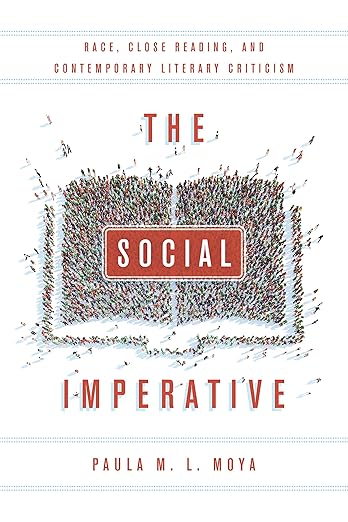
The Social Imperative
Race, Close Reading, and Contemporary Literary Criticism
Stanford University Press · Print & ebook · December 23, 2015
In the context of the ongoing crisis in literary criticism, The Social Imperative reminds us that while literature will never by itself change the world, it remains a powerful tool and important actor in the ongoing struggle to imagine better ways to be human and free.
We earn from qualifying purchases.
- Who it’s for
- Paula L. Moya connects social contexts, reading, and literary criticism through close attention to cultural ideas.
- Genres
- Race & Culture in Literature, Feminist Lit Crit, Hispanic American Lit Crit
- Published
- Stanford University Press, December 23, 2015
Nearest books
Matched by what the books are about, then ordered by what their readers also loved.
 The Black Feminist ReaderJoy James, T. Denean Sharpley-Whiting63% match
 Playing in the DarkToni Morrison63% match
 Ethics for Apocalyptic TimesDaniel Shank Cruz61% matchShares Feminist Lit Crit
 Latinx Literature UnboundRalph E. Rodriguez, Ralph Rodriguez59% matchShares Race & Culture in Literature and Hispanic American Lit Crit
 Du Bois's TelegramJuliana Spahr58% match
 Art As Performance, Story As CriticismCraig S. Womack58% match
 Distant ReadingFranco Moretti58% match
 Language As LiberationToni Morrison, Claudia Brodsky58% matchShares Race & Culture in Literature
Start with three books, and this one can be the first.
Members get a new edition every morning: a route out from their books to essays, research and talks, with the reason for each.
Join the waitlistAbout this book
In the context of the ongoing crisis in literary criticism, The Social Imperative reminds us that while literature will never by itself change the world, it remains a powerful tool and important actor in the ongoing struggle to imagine better ways to be human and free.
Continue reading
Figuring the relationship between reader and text as a type of friendship, the book elaborates the social-psychological concept of schema to show that our multiple social contexts affect what we perceive and how we feel when we read. Championing and modeling a kind of close reading that attends to how literature reflects, promotes, and contests pervasive sociocultural ideas about race, ethnicity, gender, and sexuality, Paula M. L. Moya demonstrates the power of works of literature by writers such as Junot Diaz, Toni Morrison, and Helena Maria Viramontes to alter perceptions and reshape cultural imaginaries. Insofar as literary fiction is a unique form of engagement with weighty social problems, it matters not only which specific works of literature we read and teach, but also how we read them, and with whom. This is what constitutes the social imperative of literature.
Reader-Text Friendship
Paula L. Moya connects social contexts, reading, and literary criticism through close attention to cultural ideas.
Come here for
- A reader-text friendship model using social-psychological schema
- Close readings attentive to race, ethnicity, gender, and sexuality
Expect
- Discussion of works by Junot Díaz, Toni Morrison, and Helena María Viramontes
- Attention to how literature reflects, promotes, and contests sociocultural ideas
Where it sits
| Race & Culture in Literature | 76% |
|---|---|
| Feminist Lit Crit | 43% |
| Hispanic American Lit Crit | 24% |
Percentages are BookFrontier’s reading of the book.
Publisher categories
- American Lit Crit
- Authors
- Paula L. Moya, Paula Moya
- Publisher
- Stanford University Press
- Published
- December 23, 2015
- Format
- Print & ebook
- Reading lane
- American Lit Crit