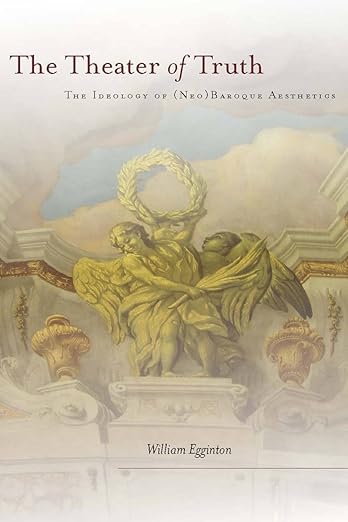
The Theater of Truth
The Ideology of (neo)baroque Aesthetics
Stanford University Press · Print & ebook · December 17, 2009
We earn from qualifying purchases.
- Who it’s for
- William Egginton links two Baroques through a shared problem of appearance, representation, and cultural politics.
- Genres
- Iberian Lit Crit, Baroque & Rococo Art History, Aesthetics
- Published
- Stanford University Press, December 17, 2009
Nearest books
Matched by what the books are about, then ordered by what their readers also loved.
 The Cornucopian Mind and the Baroque Unity of the ArtsGiancarlo Maiorino62% matchShares Baroque & Rococo Art History and Aesthetics
 Tilting CervantesBruce R. Burningham56% matchShares Iberian Lit Crit
 Neoclassicism and Romanticism: Architecture, Sculpture, Painting, DrawingROLF TOMAN50% match
 Kafka's ClothesMark M. Anderson49% match
 Aesthetic DilemmasMarlo Burks, Marlo Alexandra Burks48% matchShares Aesthetics
 Affecting GraceKenneth S. Calhoon, Kenneth C. Calhoon47% match
 Erotic MysticismNancy LaGreca47% match
 The Politics of AestheticsJacques Rancière, Gabriel Rockhill47% matchShares Aesthetics
Start with three books, and this one can be the first.
Members get a new edition every morning: a route out from their books to essays, research and talks, with the reason for each.
Join the waitlistAbout this book
The Theater of Truth argues that seventeenth-century baroque and twentieth-century neobaroque aesthetics have to be understood as part of the same complex. The Neobaroque, rather than being a return to the stylistic practices of a particular time and place, should be described as the continuation of a cultural strategy produced as a response to a specific problem of thought that has beset Europe and the colonial world since early modernity.
Continue reading
This problem, in its simplest philosophical form, concerns the paradoxical relation between appearances and what they represent. Egginton explores expressions of this problem in the art and literature of the Hispanic Baroques, new and old. He shows how the strategies of these two Baroques emerged in the political and social world of the Spanish Empire, and how they continue to be deployed in the cultural politics of the present. Further, he offers a unified theory for the relation between the two Baroques and a new vocabulary for distinguishing between their ideological values.
Hispanic Baroques
William Egginton links two Baroques through a shared problem of appearance, representation, and cultural politics.
Come here for
- The paradox between appearances and what they represent
- Art and literature of the Hispanic Baroques, old and new
Expect
- The Spanish Empire’s political and social world
- A theory relating the Baroques and vocabulary for their ideological differences
Where it sits
| Aesthetics | 38% |
|---|---|
| Iberian Lit Crit | 35% |
| Baroque & Rococo Art History | 25% |
Percentages are BookFrontier’s reading of the book.
Publisher categories
- Iberian Lit Crit
- Authors
- William Egginton
- Publisher
- Stanford University Press
- Published
- December 17, 2009
- Format
- Print & ebook
- Reading lane
- Iberian Lit Crit