
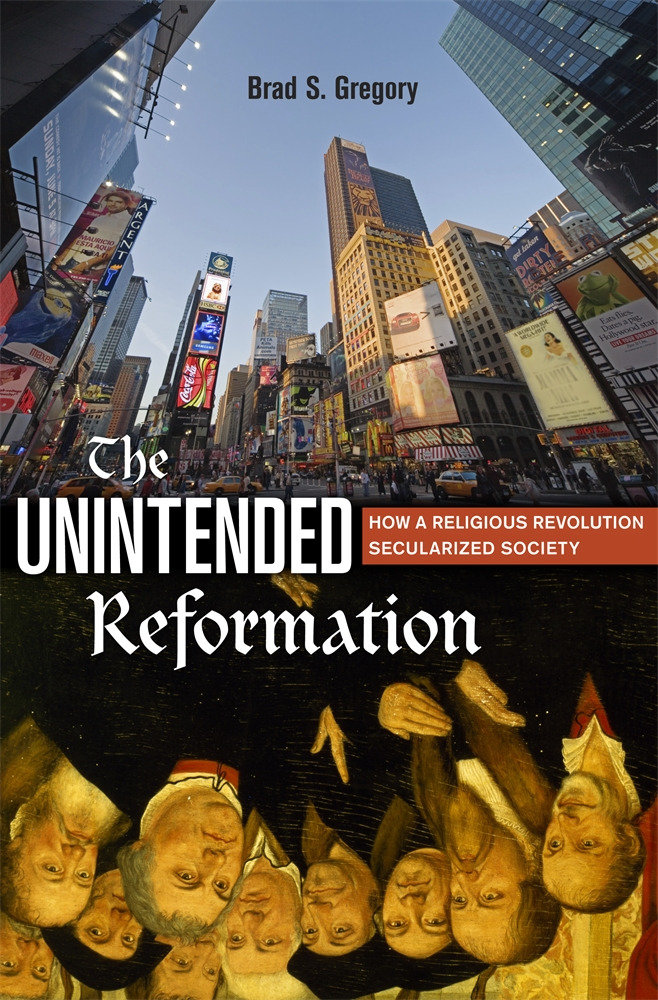
Book
Unintended Reformation
How a Religious Revolution Secularized Society
Brad S. Gregory
WW Norton · Print & ebook · November 16, 2015
Reading lane: Christian Apologetics
In a work that is as much about the present as the past, Brad Gregory identifies the unintended consequences of the Protestant Reformation and traces the way it shaped the modern condition over the course of the following five centuries.
At a Glance
Why This Clicks
Faith and Modernity
Trace how the Reformation’s unintended effects, Gregory argues, still shape the modern West.
Come here for
- A long view of religion’s role in Western social and moral life
- A searching account of pluralism, consumerism, and the common good
Expect
- Historical argument that connects medieval Christianity to present-day debates
- A contemplative read about faith, knowledge, and secular society
Book Details
- Authors
- Brad S. Gregory
- Publisher
- WW Norton
- Published
- November 16, 2015
- Format
- Print & ebook
- Theme
- Christian Apologetics · 16th-Century History
- Reading lane
- Christian Apologetics
Affinity
Publisher Categories
Historiography
21st-Century America
16th-Century History
About This Book
In a work that is as much about the present as the past, Brad Gregory identifies the unintended consequences of the Protestant Reformation and traces the way it shaped the modern condition over the course of the following five centuries. A hyperpluralism of religious and secular beliefs, an absence of any substantive common good, the triumph of capitalism and its driver, consumerism—all these, Gregory argues, were long-term effects of a movement that marked the end of more t...
Read full description
Similar Books

Rebel in the Ranks
Brad S. Gregory · HarperCollins
Affinity signal
16th-Century History
Western European History

The Protestant Reformation
Hans J. Hillerbrand · HarperCollins
Affinity signal
16th-Century History
Church History

The Reformation of the Sixteenth Century
Roland Bainton, Jaroslav Pelikan · Beacon Press
Affinity signal
16th-Century History
Renaissance History
Dominion
Tom Holland · Basic Books
Affinity signal
Western European History
16th-Century History