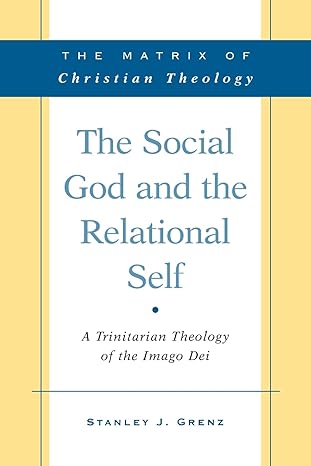
The Social God and the Relational Self
A Trinitarian Theology of the Imago Dei
Presbyterian Publishing Corporation · Print & ebook · February 5, 2007
In this volume, Stanley Grenz creatively extends the insights of contemporary Trinitarian thought to theological anthropology.
We earn from qualifying purchases.
- Genres
- The Christian Soul, Systematic Theology
- Published
- Presbyterian Publishing Corporation, February 5, 2007
Nearest books
Matched by what the books are about, then ordered by what their readers also loved. Most of these share its genres: The Christian Soul and Systematic Theology.
 Christian SpiritualityDonald Alexander47% match
 20th-century TheologyStanley J. Grenz, Roger E. Olson64% match
 God's Many-splendored ImageNonna Verna Harrison64% match
 Theological AnthropologyMarc Cortez60% match
 Created in God's ImageAnthony A. Hoekema59% match
 Theology for the Community of GodStanley J. Grenz59% match
 Dignity and DestinyJohn F. Kilner58% match
 A Jesus-shaped Life Bible Study Guide Plus Streaming VideoLisa Harper56% match
Start with three books, and this one can be the first.
Members get a new edition every morning: a route out from their books to essays, research and talks, with the reason for each.
Join the waitlistAbout this book
In this volume, Stanley Grenz creatively extends the insights of contemporary Trinitarian thought to theological anthropology. The Social God and the Relational Self is an example of theological construction as an ongoing conversation involving biblical texts, the theological heritage of the Christian tradition, and the contemporary historical/social context. Grenz develops a communal understanding of the imago dei in the face of the demise of the centered self.
Continue reading
He delineates the biblical/theological foundation for a new social conception of the divine image and reformulates an understanding of the self in a postmodern context, a context characterized by the loss of the self coupled with the quest for relationality in community. Grenz concludes by identifying the basis of the Trinitarian theological foundation for Christian anthropology and opens the door for the examination of other anthropological questions to be considered in light of the postmodern condition.
Where it sits
| The Christian Soul | 99% |
|---|---|
| Systematic Theology | 70% |
Percentages are BookFrontier’s reading of the book.
Publisher categories
- Christian Theology
- Systematic Theology
- Authors
- Stanley Grenz
- Publisher
- Presbyterian Publishing Corporation
- Published
- February 5, 2007
- Format
- Print & ebook
- Reading lane
- Christian Theology