BookFrontier
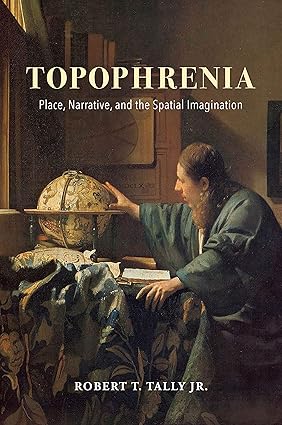
Topophrenia by Robert T. Tally Jr.

Book

Topophrenia

Place, Narrative, and the Spatial Imagination

Robert T. Tally Jr.

Indiana University Press · Print & ebook · November 9, 2018

Reading lane: Literary Criticism

What is our place in the world, and how do we inhabit, understand, and represent this place to others?

At a Glance

Who It's For

Good for readers who enjoy Literary CriticismGood for readers interested in spaceGood for fans of Philosophy

Book Details

Authors
Robert T. Tally Jr.
Publisher
Indiana University Press
Published
November 9, 2018
Format
Print & ebook
Theme
Literary Criticism · Literary Theory
Reading lane
Literary Criticism

Affinity

Publisher Categories

  • Literary Criticism

  • Literary Theory

  • Books & Reading

About This Book

What is our place in the world, and how do we inhabit, understand, and represent this place to others? Topophrenia gathers essays by Robert Tally that explore the relationship between space, place, and mapping, on the one hand, and literary criticism, history, and theory on the other. The book provides an introduction to spatial literary studies, exploring in detail the theory and practice of geocriticism, literary cartography, and the spatial humanities more generally. The...
Read full description

What is our place in the world, and how do we inhabit, understand, and represent this place to others? Topophrenia gathers essays by Robert Tally that explore the relationship between space, place, and mapping, on the one hand, and literary criticism, history, and theory on the other. The book provides an introduction to spatial literary studies, exploring in detail the theory and practice of geocriticism, literary cartography, and the spatial humanities more generally. The spatial anxiety of disorientation and the need to know one's location, even if only subconsciously, is a deeply felt and shared human experience. Building on Yi Fu Tuan's "topophilia" (or love of place), Tally instead considers the notion of "topophrenia" as a simultaneous sense of place-consciousness coupled with a feeling of disorder, anxiety, and "dis-ease." He argues that no effective geography could be complete without also incorporating an awareness of the lonely, loathsome, or frightening spaces that condition our understanding of that space. Tally considers the tension between the objective ordering of a space and the subjective ways in which narrative worlds are constructed. Narrative maps present a way of understanding that seems realistic but is completely figurative. So how can these maps be used to not only understand the real world but also to put up an alternative vision of what that world might otherwise be? From Tolkien to Cervantes, Borges to More, Topophrenia provides a clear and compelling explanation of how geocriticism, the spatial humanities, and literary cartography help us to narrate, represent, and understand our place in a constantly changing world.

Similar Books