
Book
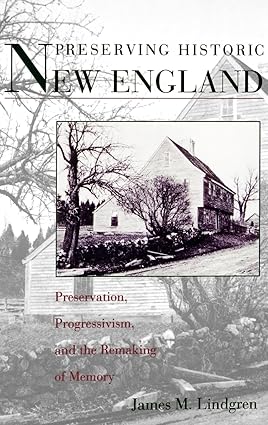
Preserving Historic New England
Preservation, Progressivism, and the Remaking of Memory
James M. Lindgren
Oxford University Press · Print & ebook · October 1, 1995
Reading lane: History of Architecture
By the first years of the twentieth century the memory of old-time New England was in danger.
At a Glance
Who It's For
Book Details
- Authors
- James M. Lindgren
- Publisher
- Oxford University Press
- Published
- October 1, 1995
- Format
- Print & ebook
- Theme
- History of Architecture
- Reading lane
- History of Architecture
Affinity
Publisher Categories
History of Architecture
About This Book
By the first years of the twentieth century the memory of old-time New England was in danger. What had once been a land of small towns populated by tradition-minded Yankees was now becoming almost unrecognizable with a floodtide of immigrants and the constant change of a modernizing society. At the same time, cities such as Boston, Portsmouth, and Salem were bursting at the seams with factories, high-rises, and uncontrollable growth. During a period when the Colonial Revival...
Read full description
Similar Books
New England's Hidden Past
Dan Landrigan, Leslie Landrigan · Down East Books
Affinity signal
New England Travel
New England History

The Emerson Circle
Bruce Nichols · Avid Reader Press / Simon & Schuster
Affinity signal
New England History
American Lit Crit
In Small Things Forgotten
James Deetz · Knopf Doubleday Publishing Group
Affinity signal
Colonial America (to 1775)
New England History

Who Owns America's Past?
Robert C. Post · Johns Hopkins University Press
Affinity signal
Exhibitions & Catalogs
Social History

The Age of Homespun
Laurel Thatcher Ulrich · Knopf Doubleday Publishing Group
Affinity signal
Colonial America (to 1775)
American Lit Crit

The History of Here
Akum Norder · State University of New York Press
Affinity signal
Middle Atlantic History
Urban Life

Anasazi America
David E. Stuart · University of New Mexico Press
Affinity signal
Cultural Anthropology
Longing for Connection
Andrew Burstein · Johns Hopkins University Press
Affinity signal
Colonial America (to 1775)
19th-Century America