
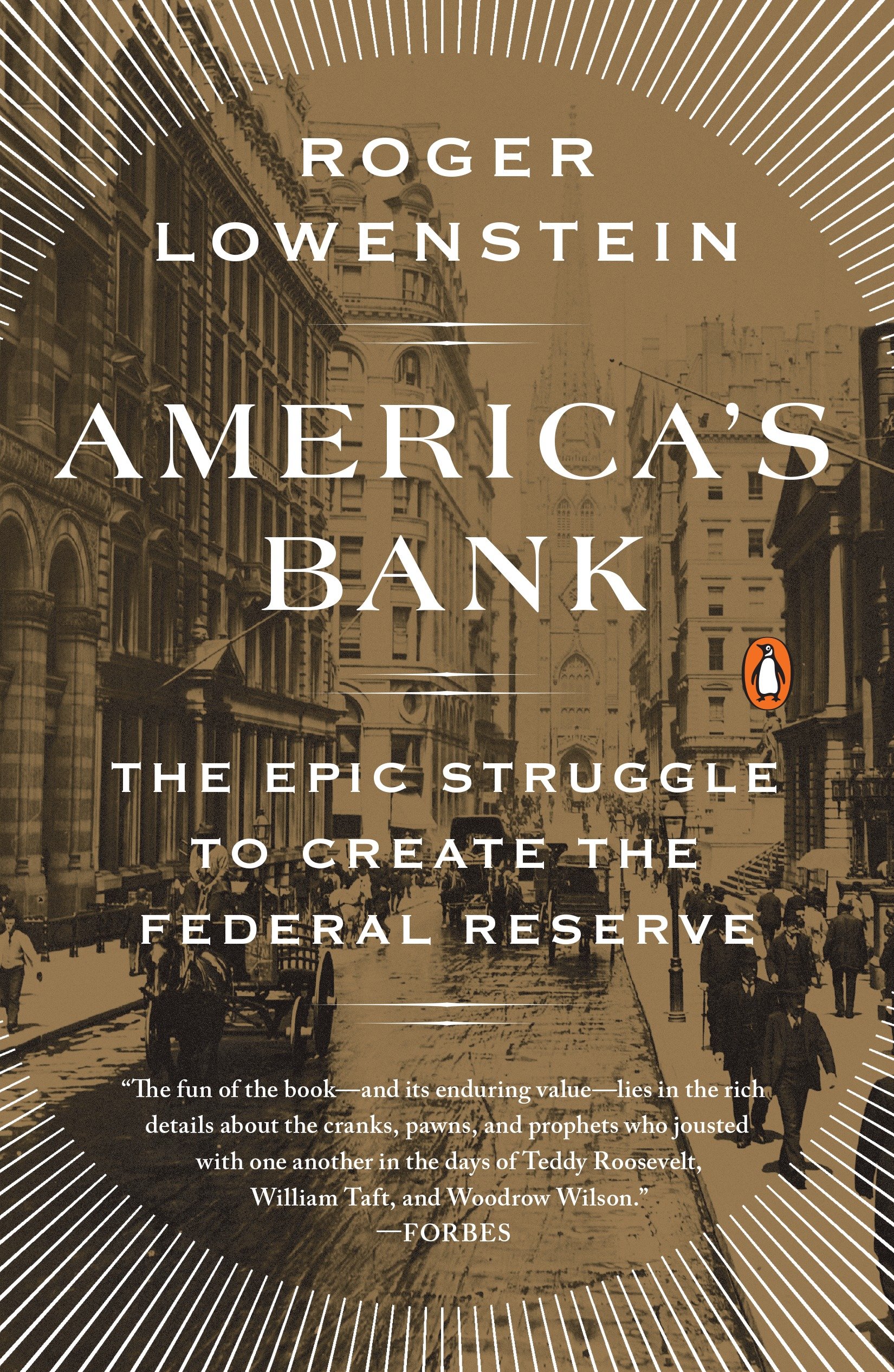
Book
America's Bank
The Epic Struggle to Create the Federal Reserve
Roger Lowenstein
Penguin Publishing Group · Print & ebook · October 18, 2016
Reading lane: 20th-Century America
A tour de force of historical reportage, America’s Bank illuminates the tumultuous era and remarkable personalities that spurred the unlikely birth of America’s modern central bank, the Federal Reserve.
At a Glance
Why This Clicks
Money Power
A lucid account of how American finance became a constitutional argument.
Come here for
- money-and-power politics
- institutional history with a sweeping historical lens
Expect
- patient narrative arc
- civic history with business stakes
Book Details
- Authors
- Roger Lowenstein
- Publisher
- Penguin Publishing Group
- Published
- October 18, 2016
- Format
- Print & ebook
- Theme
- 20th-Century America · 21st-Century America
- Reading lane
- 20th-Century America
Affinity
Publisher Categories
Banks & Banking
Corporate Histories
20th-Century America
About This Book
A tour de force of historical reportage, America’s Bank illuminates the tumultuous era and remarkable personalities that spurred the unlikely birth of America’s modern central bank, the Federal Reserve. Today, the Fed is the bedrock of the financial landscape, yet the fight to create it was so protracted and divisive that it seems a small miracle that it was ever established. For nearly a century, America, alone among developed nations, refused to consider any central or org...
Read full description
Similar Books

Americana
Bhu Srinivasan · Penguin Publishing Group
Affinity signal
Capitalism & Markets
Economic Theory

Ages of American Capitalism
Jonathan Levy · Random House Publishing Group
Affinity signal
Capitalism & Markets
Economic Theory

Too Big to Fail
William Hughes, Andrew Ross Sorkin · Penguin Publishing Group
Affinity signal
Derivatives Investing
Financial Risk Management

Lords of Finance
Liaquat Ahamed · Penguin Publishing Group
Affinity signal
Financial Services
International Economics

When Genius Failed
Roger Lowenstein · Random House Publishing Group
Affinity signal
Financial Risk Management
Stocks
The Lords of Easy Money
Christopher Leonard · Simon & Schuster
Affinity signal
Banks & Banking
Economic History
The Banks We Deserve
Oscar Perry Abello · Island Press
Affinity signal
Local Government
Financial Services

The Triumph of Economic Freedom
Phil Gramm, Donald J. Boudreaux · Bloomsbury Academic
Affinity signal
Economics
Politics & Government