What a 2019 Bahamas Dive Can and Cannot Tell You About Sixgill Sharks
The viral sixgill video shows the less important half of the 2019 dive.
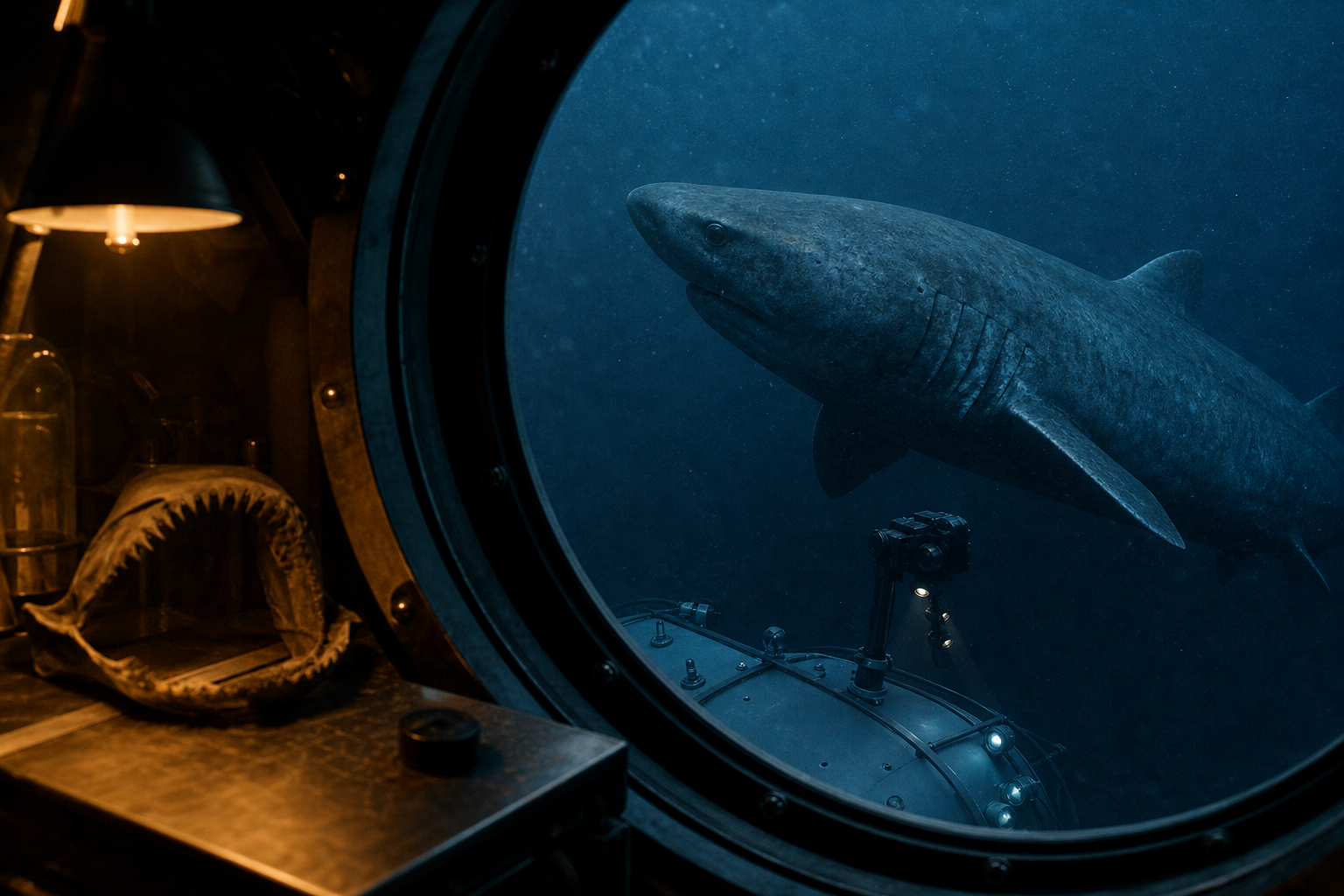
The viral sixgill video shows the less important half of the 2019 dive. The footage shows a shark estimated at 16 to 17 feet sliding up to a submersible about 1,700 feet below the Atlantic near the Bahamas. It circles the vehicle and noses the window, and the whole scene practically begs for the Jaws cello. On that same expedition, researchers attached a satellite tag to a male sixgill at depth, the first time anyone had done so. The tag records where a deep-water animal goes when nobody is shining lights on it, which describes almost every hour of a sixgill's life, and that record will never trend. So when a six-gilled shark circles a lit metal capsule in total darkness, which party is gathering data on the other?
The video supports only a short list of conclusions. The 16- to 17-foot length is an estimate drawn from footage, and sizing an animal against black water, with no fixed object for scale, produces error in both directions. The approach records one shark's response to one vehicle on one dive, under artificial light that a sixgill at 1,700 feet would otherwise never meet. The date compounds the problem: the dive took place in June 2019, and the clip is circulating again in 2026, seven years later, stripped of the scientific purpose that put the submersible there. Most coverage also skips the first thing you need to judge the encounter, which is what kind of animal a sixgill is. Why tagging one at depth counted as a first follows from that answer.
Greg Skomal's The Shark Handbook, now in its third edition, covers the entire group of animals the video shows one of. Skomal is a marine fisheries biologist in Massachusetts, known to television audiences as a Shark Week expert. The publisher promises more than 400 profiles covering every shark in existence, running from the first sharks of roughly 445 million years ago to the species alive now. The profiles are organized by order, so ground sharks, mackerel sharks and carpet sharks each sit within a family tree before any single species gets described.
For anyone stuck on the Bahamas footage, that ordering earns the book its shelf space. A sixgill makes more sense beside its relatives. The name supplies the first clue: six gill slits on each side, where most sharks have five, a body plan that sets it apart from the ground sharks and mackerel sharks most people picture. The publisher's description does not single out the sixgill, so what follows is an inference. If the profiles cover every living species as claimed, the sixgill has its own entry, filed beside cousins you have probably never heard of. In that company, the animal that filled your phone screen shrinks back to a species with a family.
Several of the book's advertised facts also bear on how scientists study an animal like this one. A whale shark's spots are as unique as a fingerprint, so a photograph can identify an individual, the same goal a tag pursues with a transmitter. Sharks can go into a trance when flipped upside down, which sounds like a party trick until you consider how anyone holds a large shark still long enough to work on it. And the megalodon's mouth, at 6 feet across, puts a 16- to 17-foot sixgill in sobering perspective.
The packaging deserves some skepticism. The description calls sharks "fierce sea creatures" and "jaw-dropping," and the book's search keywords include "killer," "jaws" and "shark attack." That is the same menace the viral framing trades on, and a book that calls sharks misunderstood is being sold partly through the misunderstanding.
Breadth has a cost too. Spread more than 400 profiles across one volume and most entries have to be short. Expect identification and essentials for the sixgill, and probably very little about what a deep-water shark does after a tag goes on.
I would still keep this handbook open beside the footage ahead of any shark documentary. Documentaries supply more footage, and the viral moment already has plenty. A reference organized by kinship hands you the comparison set, with the sixgill and its relatives gathered in one place.
The 2019 expedition's lasting product is a dataset the viral footage never shows. The supplied reports confirm that a male sixgill was tagged at depth for the first time, on June 29, 2019, more than 1,700 feet down. They do not say what the tag recorded or how long it kept transmitting, and that silence is the weakest part of the coverage. The record is where the sixgill story goes next, and if it surfaces, expect tracks and depth readings that will never rack up shares. If the clip sent you looking for something sturdier than a caption, Skomal's handbook will keep the animal in context while the slower science catches up. The shark that approached the submersible was conducting its own inspection. The tag simply returned the favor.
Why this book
Picture running the Bahamas video again with the handbook open to the sixgill entry. The shark rises toward the lit submersible, and on a phone screen that rise reads as menace. Beside the profile of a deep-water species, the same approach looks like an animal investigating light and vibration in water where neither normally exists. The reporting on the dive describes the female as curious, and nothing in the footage contradicts that, though no camera can measure a shark's motive. The 16- to 17-foot estimate gets its own test. With a printed length range in front of you, you can ask whether the animal on screen sits at the large end of its species or past it. The book will not settle that question, because the footage figure is itself an estimate, yet a printed range gives the number something solid to push against. With the sixgill placed as one species among more than 400, the 2019 tagging moves to the center of the story. A first tag at depth suggests scientists had known this animal mostly through brief encounters, and the clip spreading in 2026, for all its drama, adds one more brief encounter to the file.
Bridges by email
A news story and the book that goes with it, whenever we publish one.